
Govardhan Puja and Bhai Dooj: The Two Days Nobody Plans For

Diwali is remembered as one night. It is five days, and the two at the end fall out of the plan: by the time Govardhan Puja arrives the house has had its big evening, and by Bhai Dooj half the family is travelling. Both carry rites older and stranger than the lamps. In 2026 both also land on a date a good many calendars will print wrong, with an empty Monday in the middle.
The gap on Monday the 9th
Govardhan Puja is Tuesday 10 November 2026. Bhai Dooj is Wednesday 11 November. Lakshmi Puja was Sunday the 8th, which leaves Monday the 9th with nothing on it.
The gap is real, and it comes from the two rites keying on different parts of the day. Amavasya is running on Sunday evening, and Lakshmi Puja is an evening rite — so Diwali night is Sunday the 8th. That same Amavasya is still running at sunrise on Monday the 9th, and lets go only at 12:31 in the afternoon. Govardhan Puja is a morning rite on Pratipada, the first day of the bright fortnight, so it cannot sit on a morning that is still Amavasya. It moves to Tuesday, when Pratipada is current at sunrise and holds until 2:00 PM. Bhai Dooj follows on Wednesday, Dwitiya at sunrise until 3:53 PM.
Panchangs that simply count forward from Diwali print 9 November for Govardhan and 10 November for Bhai Dooj. If that is what the family calendar says, it is not a misprint but a different rule — counting days rather than reading tithis. We follow the tithi; the whole five-day sequence is set out elsewhere.
Annakut means a mountain of food
Behind the first day is a quarrel with a god. Krishna tells the cowherds of Gokul to stop propitiating Indra and honour Govardhan hill instead, since the hill is what actually feeds their cattle. Indra sends a storm; Krishna lifts the hill and holds it over the village, and after seven days of unbroken rain Indra gives up.
What the festival does with that is not a re-enactment. It is a meal. Annakut means a mountain of food, and the offering is exactly that: a mound of cooked grain standing in for the hill, with the rest arranged below it in tiers, sweets nearest. Fifty-six items, the chhappan bhog, are prepared in the days before.
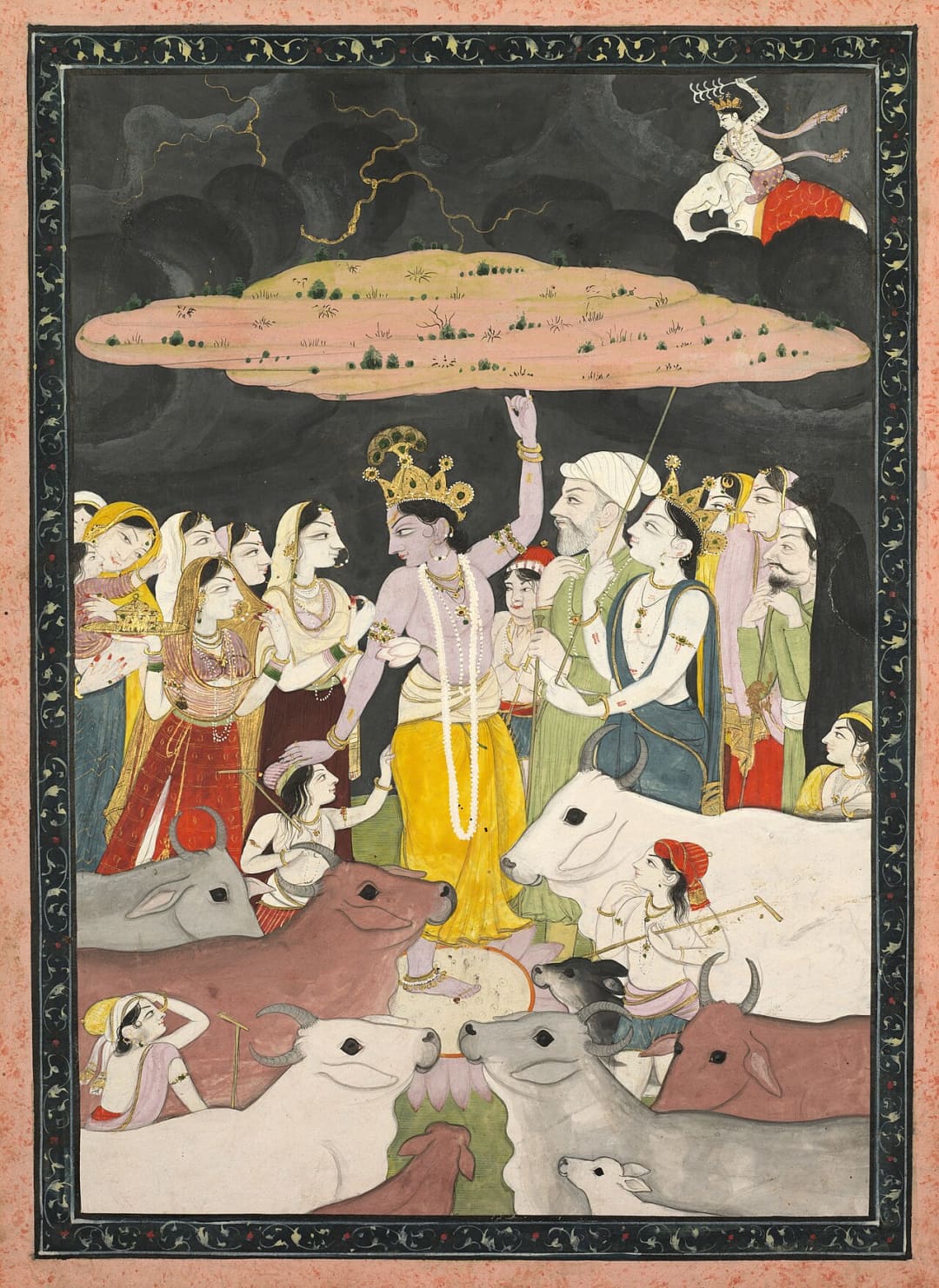
It is the most literal offering in the year. Most rites give god a little of something. This one gives a hill.
At Nathdwara the mound has to be built
The tradition is largest in Pushtimarg, the Vallabha lineage, whose central image is Shrinathji at Nathdwara — Krishna as a seven-year-old child, the age he was when he lifted the hill. On Annakut the food is assembled in the Doltibari, the main audience hall of the haveli, and the rice is not a bowl of rice but a structure, built up by the quintal into the shape of Govardhan.
Then it is taken apart. Communities from across Mewar come to loot the annakut, and the looting is the privilege, not something tolerated at the edges: Krishna, the explanation goes, wanted the food shared with all of Vraja rather than kept at the shrine.
The hill people make at home
Away from the havelis the hill is made of cow dung. Families shape a low mound of it on the courtyard floor, set miniature cows around it, and press in grass and twigs for trees. It is built rather than bought, which is most of the point. The same morning is Bali Pratipada and Gujarat's new year, Bestu Varas — Tuesday the 10th in 2026, not Lakshmi Puja night.
Two cow days bracket these, and they are not the same rite. Govatsa Dwadashi, Thursday the 5th, honoured the cow and her calf. Gopashtami is Shukla Ashtami, Tuesday 17 November: the day Nanda gave Krishna charge of the cows of Vrindavan. One honours the pair; the other the boy who stopped being a child.
Bhai Dooj is Yama's day, not Rakhi's
The second day is a brother-and-sister festival, routinely called Raksha Bandhan's autumn twin. It is not. Its other name is Yama Dwitiya, and the story is a visit: Yama, the god of death, calls on his sister Yamuna on Dwitiya, and she receives him and feeds him.
The register is different. At Raksha Bandhan a sister ties a thread and a brother promises protection. Here she puts a tika on his forehead and performs aarti with a lamp, and what is asked for is not protection from the world but time — from the one god who has the last word on how much of it there is. The guest at the origin of this festival is death itself, politely fed.
The same day, under four names
- Bhai Phota, Bengal — the second day after Kali Puja, the tika in sandalwood paste, curd and kajal.
- Bhau Beej, Maharashtra, Gujarat and Goa — the aarti, then basundi puri.
- Bhai Tika, Nepal — a long tika of seven colours in place of one red mark.
- Yama Dwitiya, in the south — the one name that keeps the point on the surface.
Godhan, and the sisters who curse their brothers
In Bihar the day is Godhan, and it is the strangest rite of the fortnight. Sisters make figures out of cow dung — Godhan, Yama and Yamuna, snakes and scorpions — and keep a nirjala fast, without water. Then, in the morning, they abuse their brothers: curse them, insult them, say the worst thing they can think of, out loud.
Then they prick their own tongues with a thorn, as penance for having said it.
The explanation families give inverts what the ritual looks like. Yama is said to come for the people nobody has ever cursed, so a brother already cursed by his sister is accounted for and can be passed over. The abuse is cover. The thorn is for having had to use it. The figures are struck with a pestle; the brothers get gram, sweets and a blessing for long life. We roll incense a short way from where this is kept, in Samastipur, and it is still not a rite anyone explains the first time you ask.
Chitragupta Puja: the clerk of the same court
On that same Wednesday, Kayastha households keep Chitragupta Puja — and once you know who Chitragupta is, the pairing stops looking like a coincidence. He is the registrar. He keeps the record of what everyone has done, the Agrasandhani, and it is his register that is read out in Yama's court. Yama Dwitiya is the judge's day. Chitragupta Puja is the clerk's. Same court, same date.
So what is worshipped is the equipment: the pen, the inkpot, paper, the account ledgers. It is called Kalam Dawat Puja, and it is as near as this calendar comes to a festival of literacy. Chitragupta is always shown with a pen and a book, and the Kayastha tradition takes itself as descended from him.
What the accounts do not settle
Two things I could not get a straight answer on. The first is the writing. Some accounts have the pen and inkpot venerated during the puja itself; others say the household sets pens and paper aside for the day and venerates them the next morning. Both are described as the tradition, by people keeping it.
The second is the date: the puja is printed as "the second day of Diwali" in some places and "the second day after Diwali" in others, which are not the same day. The tithi is the stable thing — Dwitiya.
Three of the four dhams close on these days
Up in Garhwal the same two dates do something else. Gangotri closes for the winter on Annakut, Tuesday the 10th; Yamunotri and Kedarnath on Bhai Dooj, Wednesday the 11th. The shrine calendar is pinned to the festival rather than to a number, which is why the closing dates move every year with Diwali.
Yamunotri is the source of the Yamuna. It shuts its doors for the winter on the day that exists because Yamuna received her brother. Nobody designed that, and no official notice mentions it. It is there anyway.
What the two days are for
Between them these two days make a small argument about what is owed. Annakut feeds a god a hill of food, then hands the hill to whoever turns up for it. Godhan looks after a brother by insulting him. Chitragupta Puja puts a pen down out of respect for the fact that someone is keeping count.
None of that fits on a greeting card, which is part of why these two days get skipped. If you keep only one, cook more than the house needs on the Tuesday and give the surplus away. That is Annakut, scaled to a kitchen.


