Dev Deepawali 2026: The Night Varanasi Lights the River
The famous photograph of Varanasi is the night one: the priests at Dashashwamedh Ghat with their tiered brass lamps, the smoke standing up in the floodlights, boats three deep with cameras. We have written before that this is evening theatre rather than the ghats themselves, and on an ordinary weekday that is fair. That piece called it just a Tuesday.
Dev Deepawali 2026 is also a Tuesday. It is the opposite of just.
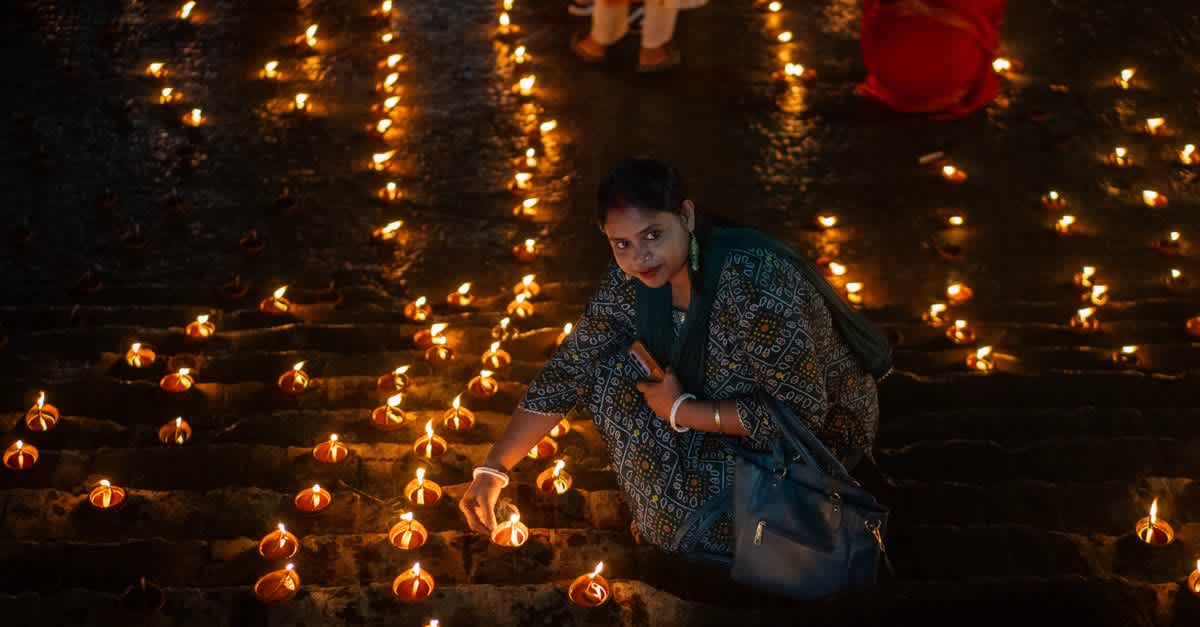
One night in Kartik, the whole six-and-a-half-kilometre curve of stone steps is lit end to end with small earthen lamps — well over a million of them. It is the one night of the year when the river, not the temple, is the altar.
The date, and why this one does not split
Dev Deepawali 2026 is Tuesday 24 November. The Pradoshakal Dev Deepawali muhurat for Varanasi runs 5:08 PM to 7:47 PM — two hours thirty-nine minutes, beginning essentially at sunset. The Kartik Purnima tithi begins at 11:42 PM on Monday 23 November and ends at 8:23 PM on Tuesday 24 November.
Readers here are used to us hedging festival dates, because most deserve it. This one does not. The tithi begins late on the 23rd and is still running at sunrise on the 24th, so the 24th is the day on every panchang, and the observance falls inside the dusk window of that same evening. There is no second opinion to report.
Three days earlier there is. Prabodhini Ekadashi — the day Vishnu is woken and the wedding season reopens — does split in 2026: Friday 20 November for Smarta observance, Saturday 21 November for Vaishnava. Do not let the two blur. One is a genuinely contested date and the other is not.
One detail worth knowing: the muhurat closes at 7:47 PM but the tithi runs until 8:23 PM, so the auspicious window shuts thirty-six minutes before the full moon does. The lamps, of course, burn as long as their oil lasts.
What is actually being done
The act is deepdan — the gift of a lamp. Not lighting one for your own house, which is Diwali's business, but giving one to the river.
The belief behind it is specific: on the Kartik full moon the gods are held to come down to bathe in the Ganga, and the lamps are laid out to receive them. Hence the name — the Diwali of the gods, kept a fortnight after the one the rest of us keep. The day is also called Tripura Purnima, after Shiva's defeat of the asura Tripura, and the two readings sit side by side without anyone appearing to mind.
In practice it is thousands of people buying a few diyas each on the steps, filling them with oil, setting a cotton wick, and placing them on the stone. Not floating them, mostly — the floating-lamp image is real but smaller than photographs suggest. Most of the lamps sit on the ghats, placed by hand, one at a time, by whoever turned up.
Where it happens
Varanasi has eighty-four ghats, the same stone line that on an ordinary morning belongs to bathers, boatmen and buffalo. On Dev Deepawali the lighting runs essentially the whole length of it, from Ravidas Ghat at the southern end to Rajghat in the north, with Dashashwamedh as the ceremonial focus and the place the television cameras go.
Running alongside it is the Ganga Mahotsav, a five-day cultural festival from Prabodhini Ekadashi to Kartik Purnima — so in 2026, roughly the 20th through the 24th. Dev Deepawali is its last night and its reason for existing.
Panchganga, and the lamps that came first
Here the sources disagree, and the disagreement is the interesting part.
One well-sourced account credits the lamp-lighting to Pandit Kishori Raman Dubey — Babu Maharaj — at Dashashwamedh Ghat in 1991. Other accounts put the beginning at Panchganga Ghat in the mid-1980s, with a group of young men who lined their own ghat with diyas and watched the idea spread one ghat at a time. We cannot settle which is right, so take the coarse version: the city-wide festival as it now exists is about forty years old, no older, and it grew out of one ghat rather than being decreed for all of them.
What makes Panchganga's claim worth taking seriously is that something much older was already happening there. Through the whole month of Kartik, Panchganga raises akash deep — "sky lamps": tall bamboo poles with small baskets hung from them, a lamp lit inside each. They are not for the gods coming to bathe. They are for the dead, lit to show ancestors the way, and they go up for the month rather than for one evening.
So Panchganga had a Kartik lamp tradition long before anyone counted lamps in lakhs. The spectacle is new. The habit it grew out of is not.
Who makes ten lakh diyas
This is the part we find hardest to look away from, because it is our own trade seen from a different angle.
A diya is a thrown clay cup, fired once, sold for almost nothing, used for an evening and broken. A million of them is an industrial order placed on a cottage industry. The potters — kumhar, the Prajapati community — begin months ahead, because a wheel turns at the speed a wheel turns and clay dries at the speed clay dries. Uttar Pradesh maintains a Maati Kala Board partly to route this kind of demand to them. When Ayodhya needed fourteen lakh diyas for its Deepotsav, potters were reportedly given about two months, which tells you how tight the arithmetic gets. Recent years have also included around one lakh lamps pressed from cow dung rather than clay, promoted as the eco-conscious share of the order.
It is the same thing that interests us about halmaddi, or about jigat: the visible object is a throwaway clay cup, and behind it is a supply chain with a season, a labour force and a deadline. We roll incense by hand in Samastipur, a day's travel east of Varanasi, and the rhythm is familiar — the festival is one evening and the work is one autumn. On the same full moon, in our own part of Bihar, the clay birds of Sama Chakeva are being broken and given back to the water. Mithila's Kartik Purnima ends in clay too.
Before the lamps: the silt
The least photographed preparation is also the most revealing. The Ganga spends the monsoon over the lower steps, and when it goes down it leaves silt. Before a single diya can be placed, the ghats have to be dug out. Varanasi's Nagar Nigam runs this as a logistics exercise — ghats divided into zones with sanitation inspectors assigned, worship ghats cleared first, extra labour put on specifically to shift silt. Ahead of the 2025 festival the mayor, Ashok Kumar Tiwari, put it simply: the cleaning proceeds as the water level recedes.
You cannot schedule that. Everything else about the night — the lamp order, the Mahotsav programme, the boat bookings — is planned against a date fixed years in advance by a tithi. The surface the lamps actually stand on is cleared at the river's convenience, a few weeks out.
How many lamps, really
Published figures are all over the place: ten lakh, eleven lakh, seventeen lakh, twenty lakh. They are mostly answering different questions — the larger numbers are the whole city, the smaller ones the ghats alone. In 2024 the reporting put roughly eleven lakh lamps on the ghats and over seventeen lakh across Varanasi.
So: the ghats take something over a million, the city well over a million and a half. A precise total is always a target, not a count. Nobody counts them afterwards.
The things I could not find out
Two, and we would rather say so than invent.
What happens the next morning. A million fired clay cups, oily, many broken, on wet stone beside a river already carrying the city's load. Somebody clears them. We could not find a single published account of it, which is strange for a festival this heavily covered — every camera is there the night before and gone by sunrise.
Who the vendors are. The lamps reach the steps through someone, and whether that is the potters themselves, a wholesale layer, or committees buying in bulk per ghat, we do not know.
Nor have we stood on the ghats on that night. This is reported, not remembered, and where a number was contested we have said so rather than picked the impressive one.
If you are going, plan around direction rather than the hour. The crowd at Dashashwamedh will be immovable well before the muhurat opens — and a ghat with no camera on it is lit exactly the same as the one with forty.