
Sama Chakeva: Mithila's Clay Birds and a Sister's Name

In our lane in Darbhanga the sound comes before anything is visible. It is late Kartik, the evenings have turned cold enough for a shawl, and somewhere past the last house a group of girls is singing — not film songs, the other kind, the ones that end each verse on a long flat note that always sounded to me like a question nobody expects answered. Then they come round the corner with a wide bamboo tray on the head, and lying in it on straw are birds made of mud.
My grandmother called this Sama Chakeva. She played it as a girl, my mother played it, my sisters played it in the yard behind our house. I never did, because boys do not. A boy's whole part comes on the last night.
The story, as it was told to us
Sama was a daughter of Krishna. She was married, and she used to go out to the forest at Brindavan where the sages kept their fires. A man named Chugla watched her going and coming, and carried word to her father that she was meeting someone she should not have been. Krishna believed him. He cursed his daughter into the body of a bird and sent her out of the house.
Her brother Samba would not accept it. He went after her and did penance until the curse lifted and his sister stood before him as herself again. Chugla was punished. It happened, the old women say, on the full moon of Kartik.
That is the whole of it. No battle, no demon. A girl is lied about, and her brother spends himself undoing the lie.
Where the tellings come apart
Ask three households and you will get three versions, and I would rather set them side by side than pretend one is correct.
Most tellings I grew up with make Chakeva the husband, cursed alongside her, and Samba the brother who saves them both. Plenty of printed accounts call Chakeva the brother instead. The husband's name shifts too — Charudatta in some, Charuvakra or Chakravak or Chakradhar in others. Whether Krishna pronounces the curse himself or a sage's word brings it down depends on who is speaking.
None of this is a defect. The story lived in courtyards long before anyone wrote it down, and courtyards do not keep minutes.
It is also worth saying plainly that this narrative is not in the Bhagavata. Samba is a Puranic figure, a son of Krishna and Jambavati; a daughter named Sama is not. This story belongs to Mithila. That does not make it small — it makes it ours.
The bird it is named after
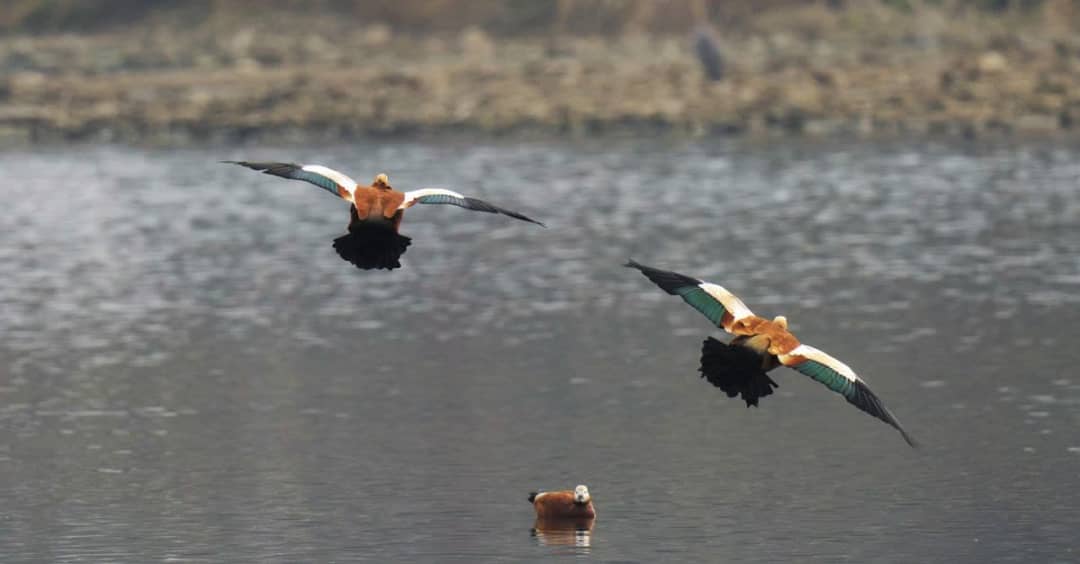
Chakeva is chakravaka — the ruddy shelduck, Tadorna ferruginea, the rust-orange duck with the pale head that Hindi calls chakwa for the male and chakwi for the female. In classical Sanskrit poetry this bird is no minor character. The chakravaka pair is the standing image for lovers forced apart at nightfall, calling across the water until dawn lets them back together. Poets reached for it for centuries the way they reached for the moon.
So a festival about a woman driven out of her father's house is named for the bird an entire literature had already made the emblem of separation.

And the bird is not a metaphor. Ruddy shelducks are winter visitors to the plains. The eastern birds cross the Himalaya to get here, at heights recorded above six thousand metres, and come down onto the sort of shallow water that lies around Mithila once the rains drain off. They arrive in these weeks. The story, the ritual and the birds are keeping the same calendar.
What else is in the tray
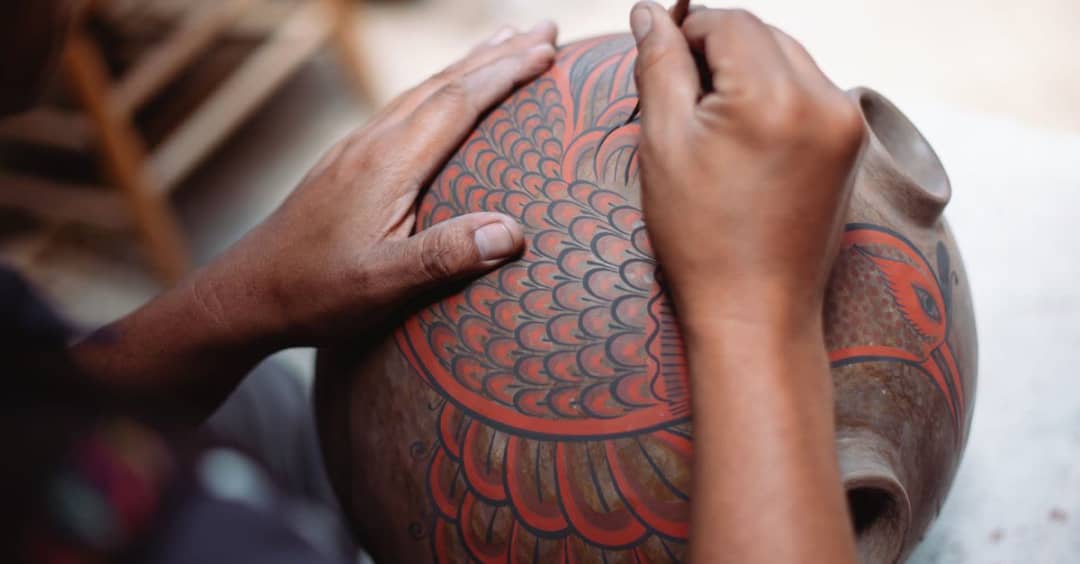
Sama and Chakeva are only two of them. The set includes Chugla, a clay Brindavan for the grove, the sages, a dog, a drummer, a man with cymbals, a jungle fowl, a bumblebee. They are shaped from river clay and painted, and the painting is the part the girls argue over — the same hands and pigments that produce the aripan drawn on Mithila floors go into the wings of a mud duck.
The tray is a changeri. It goes up onto the head and out to the fields after dark, night after night, songs the whole way.
The only thing that burns
Chugla gets a moustache of jute. On one of the nights it is set alight, and the girls sing a line I heard every year of my childhood — chugla ke mochh mein aag lagalai, the informer's moustache has caught fire — and his clay mouth is left blackened.
Notice how unusual that is. In most of our festivals the fire is a lamp or an offering. Here the one flame of the week is a punishment, aimed at a man who told tales about a woman. A village that spends every winter teaching its daughters to set light to a gossip's face is saying something direct about what it considers dangerous.
Not protection — reputation
This is where Sama Chakeva parts from the other sibling festivals, and it took me a long time to see.
At Rakhi and at Bhai Dooj the sister asks for her brother's long life and the brother undertakes to keep her from harm. The threat is out there somewhere, vague and physical. Sama is never in physical danger. She is slandered. What her brother repairs is not her safety but her name, and he cannot do it with strength — he wears himself down until the lie is undone. That is a harder thing to promise than protection, and a more useful one.
The last night
On Kartik Purnima the tone changes. Sisters feed their brothers chiura, dahi and gur — the flattened rice, curd and jaggery this part of Bihar reaches for at every serious moment. Then the brothers carry the trays out, and the clay is broken and given to the water or left in an open field.
Not as a disposal. As a vidai, the send-off of a married daughter leaving her father's house — and the songs at the end are the songs sung to a girl who is going. A brother-sister festival that closes on a goodbye rather than a reunion is a strange and honest thing.
When it falls, and why you will see three answers
Everyone agrees on the end: Kartik Purnima, which in 2026 is Tuesday 24 November.
The beginning is where accounts differ. Some households start the evening Chhath finishes, on Kartik Saptami — Chhath in 2026 runs 13 to 16 November, sunset arghya on Sunday the 15th, sunrise arghya on Monday the 16th. Others begin earlier, at Kharna. You will see the length given as seven days, as eight, and as ten, all with equal confidence.
Do not take my word for the start, or a calendar website's. Ask at home, or look at the Mithila panchang your family uses.
Who is left to carry the tray
The festival needs brothers standing in a field on the last night, and the brothers have gone — to Delhi, to Punjab, to the Gulf. Reporters who visited these villages a couple of winters ago came back with the same account from every older woman: the groups shrink each year, the younger girls do not know the songs, and the figures are bought ready-made from the potter instead of made in the yard, which removes the week of shared work that was half the point.
Some of it is being rebuilt elsewhere. One woman who moved to a city started it again in her building with three participants and had twelve the next year. Anyone who has kept Rakhi going at a distance will recognise that effort.
What to listen for
If you are in Mithila in late November, walk out towards the fields after dark. You will hear it long before you see the tray. And if you are somewhere else, the birds still are — the rust-coloured pair on the edge of any winter water, sitting slightly apart.
I am not a pandit and I never sang a line of these songs; they were not mine to sing. I only carried the tray on the last night, the way the boys in our lane did, and set it down at the water.


