
Durga and Mahishasura: the story of the nine nights

Good defeats evil. That is the sentence Navratri usually gets outside India — on a studio noticeboard, in a festival listing, in the caption beside a photograph of a clay goddess. It is not wrong. It is just so short that nothing survives it.
The story underneath is written down. It sits in a text called the Devi Mahatmya, also known as the Durga Saptashati or the Chandi Path: seven hundred verses in thirteen chapters, sitting inside the Markandeya Purana as the chapters numbered 81 to 93, and dated by scholars to somewhere around 400–600 CE. It is recited through Sharad Navratri. Households that cannot manage all seven hundred verses recite the middle section on its own — chapters two to four, which is the Mahishasura story.
Read plainly, without anybody improving it, it is a far better story than the summary suggests.
It opens with two men who have lost everything
The demon never appears first. The text opens with a king called Suratha, who has lost his kingdom, and a merchant called Samadhi, who has been thrown out by his own family. The two meet in a forest, at the ashram of the sage Medhas, where each has gone to get away from the world.
Their question is not a theological one. It is closer to something you would hear in a quiet room on a Tuesday evening: why do we still think about them? The king still worries about his lost kingdom. The merchant, robbed and abandoned, still feels affection for the family that did it. Neither can let go of the thing that ruined him, and both want to know why the mind works that way.
The story of the goddess is the sage's answer to that question. Everything that follows — the demon, the battle, the severed head — is told to two men sitting in a forest asking why attachment outlives the thing it was attached to.
Most retellings cut the frame. It is the first thing to go when the story is compressed into a festival caption, and it is the one piece that tells you what the story is actually for. The name the sage uses for the goddess in that opening episode is Mahamaya — in the text, the power that holds the world in its delusion, and that lays Vishnu down in sleep on the cosmic ocean between one universe and the next.
The demon who could not be killed by a man
Mahishasura is the son of the asura Rambha. What he holds is a boon, and the boon is the whole plot: no man could kill him. Different retellings phrase it from either side — that no man could kill him, or that only a woman could defeat him — but it is the same hole in the same contract.
With that protection he made war on the devas, defeated Indra and the gods who followed him, and took the heavens. The gods were not merely beaten. They were beaten permanently, because the terms of the boon meant that none of them could ever be the one to win.
There is something very exact about this as a piece of storytelling. He had not been careless. He had thought about every opponent he could imagine, and the one he left out was the one he could not imagine.
A goddess assembled out of other people's anger
What the text describes next is not a rescue. It is a pooling.
The gods, angry and with nothing left to do with the anger, release their energies, and the energies combine into a single mass of light, and the light takes form as Durga. She is not summoned from somewhere else. She is made, on the spot, out of what the defeated gods had and could not use.
Then they arm her, each handing over his own weapon. Vishnu gives his discus. Vayu, the wind, gives his bow and arrows. The Himalaya gives the lion she rides. The lists vary between versions — this is a story that has been told for fifteen hundred years and the inventory drifts — but the shape never does: every god gives away the thing that had failed in his hands.
The fight, and the detail people miss
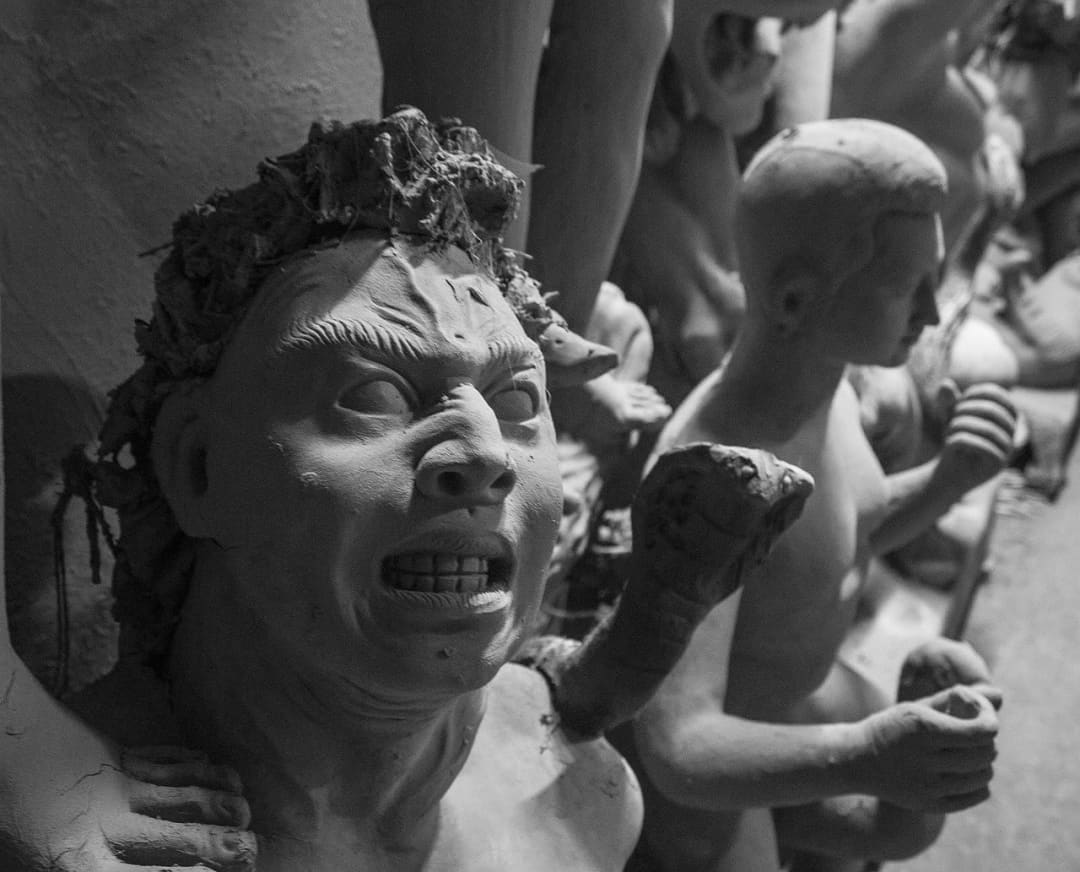
She rides out and meets him, and he fights the way his boon taught him to fight — by changing shape. He becomes the buffalo. She takes hold of the buffalo and cuts off its head, and when the demon's own essence comes up out of the severed neck she destroys that too. The trident, the trishula, is the weapon that finishes it. The epithet she carries out of this is Mahishasura Mardini — slayer of the buffalo demon — and it is one of the most repeated images in all of Hindu sculpture.
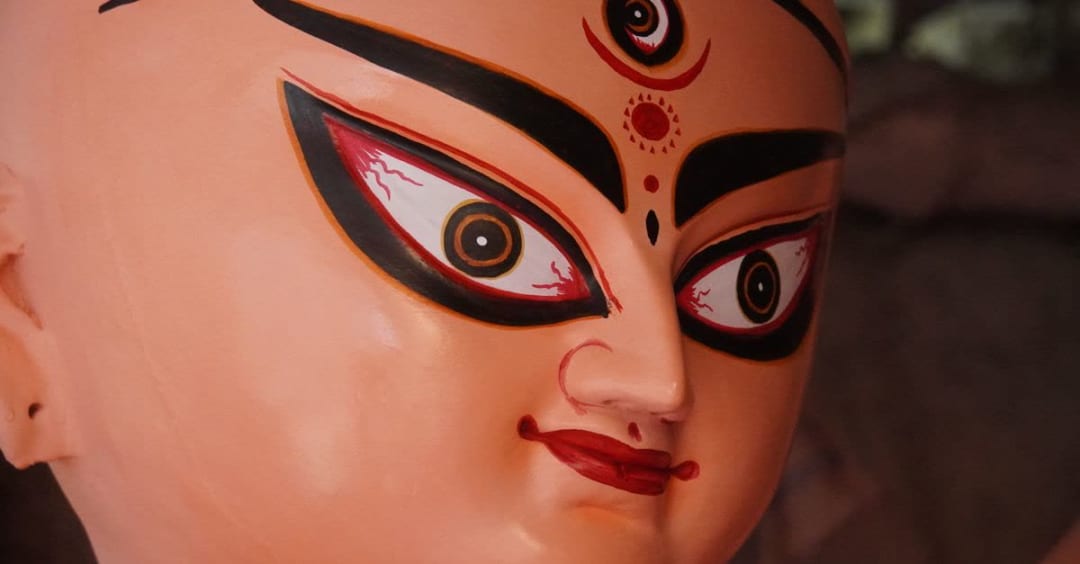
Here is the part that surprises people who look properly at an idol instead of reading about one. Her face is calm. The convention is near-universal: she is shown serene, composed, almost unhurried, at the exact moment of the kill. The violence is all in the lower half of the composition — the lion, the buffalo, the spear going in. Above it, nothing is angry. Whatever the image is saying, it is not saying rage.
The story has more than one teller
It would be dishonest to present this as a single settled account, because it is not one.
Among the Asur people, Mahishasura is remembered as a benevolent ancestor, and the community mourns during the days of Durga Puja. The Santal and Asura communities worship him as Hudur Durga, hold him to have been an ancestral king killed by deception, and read the goddess as the villain of the episode. I am not going to arbitrate that here, and nobody writing a festival article should pretend to. A story this old and this widely held is not the property of one telling, and knowing that there is another one is part of knowing the story at all.
There is a geographical layer too. The popular legend around Mysuru holds that the city's name comes from Mahishasura, that he was killed on the hill above it, and that the Chamundeshwari temple stands where it happened — which is why the climb up Chamundi Hill is a Dasara ritual in Karnataka and not merely a view.
When it falls in 2026
The nine nights of Sharad Navratri begin with Ghatasthapana on Sunday 11 October 2026 and run to Vijayadashami on Tuesday 20 October, by the New Delhi reckoning — the tithi times shift by city, so a panchang set to your own location is worth checking before you fix anything.
Eastern India keeps the same fortnight on a different frame. Durga Puja proper runs Shashthi on Friday 16 October through to the Bengal visarjan and Sindoor Utsav on Wednesday 21 October, which is why the two observances can look like one festival from outside and feel like two from inside. If that distinction is new to you, it is worth understanding how the nine nights and the four days differ before you plan around either.
What the nine nights are actually for
Go back to the forest. The sage does not tell Suratha and Samadhi this story so that they can take a side. He tells it to two men who cannot stop thinking about what they have lost, and the answer he gives them is a story about a power that makes the world hold on — and that can also be asked to loosen the grip.
That is a strange, adult thing for a festival to be built on, and it survives in the ordinary shape of the days. A lamp lit at the same hour each evening. A pot of barley sown on the first morning and watched, quietly, for nine days. A recitation that most people do not finish and do not pretend to. Nobody is cheering a battle. They are keeping an appointment with the same room, at the same time, for nine evenings running, which is a discipline that does not need a demon to justify it.
If you do nothing else this October, read the middle chapters. Then look at an idol — properly, at the face — and see whether it still means what the four-word version told you it meant.


