
How Dhoop Cones Are Made: A Workshop Walk-Through
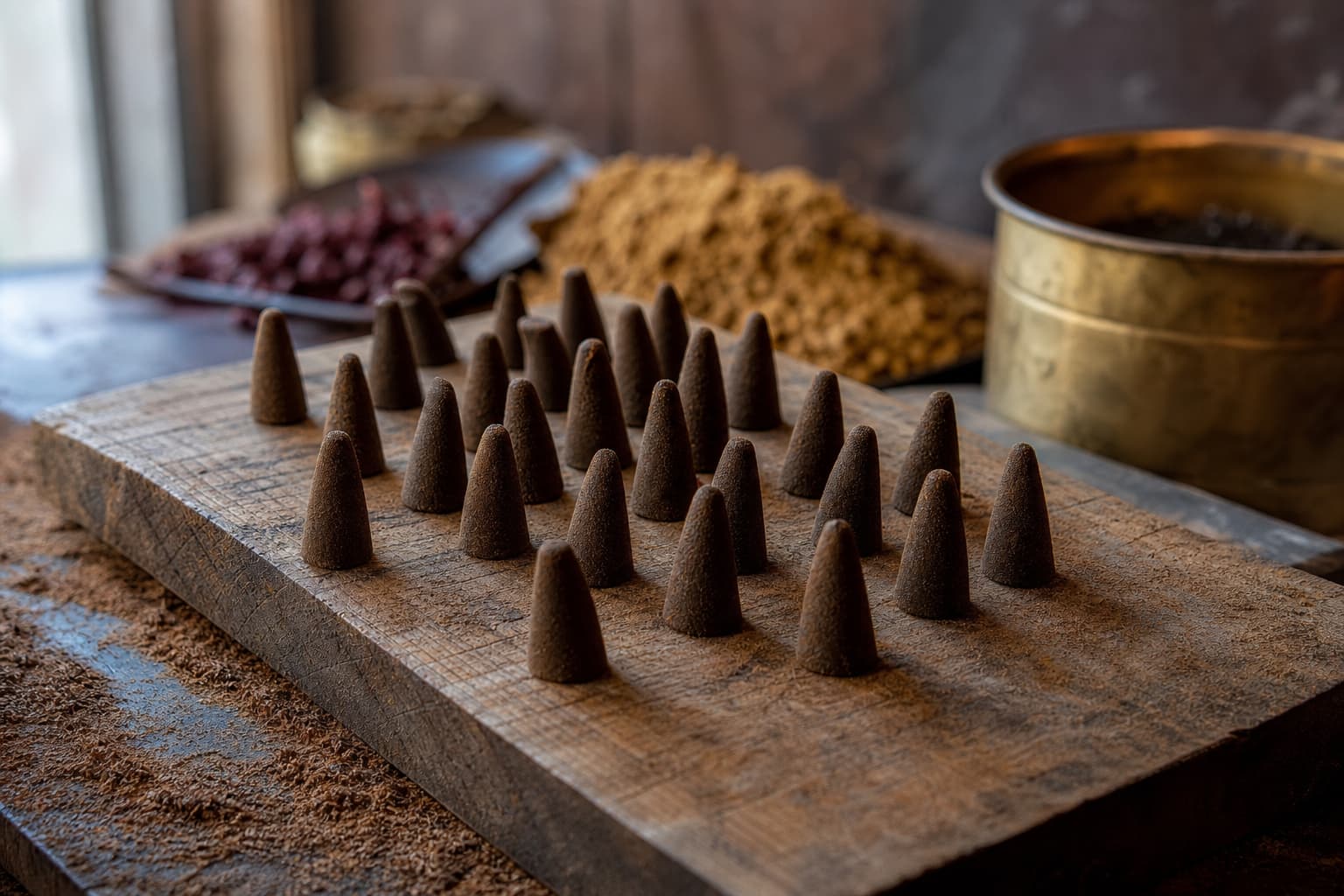
The first smell I remember is not a stick. It is a cone.
At the Vadakkunnathan temple in Thrissur, and in my grandmother's house a lane away from it, the evening did not begin with a matchstick and an agarbatti. It began with a small dark cone set on a brass plate, lit at the tip, blown out, and left to glow. The smoke did not rise in a thin thread the way stick smoke does. It came up in a slow, thick column, folded over itself, and filled the room from the floor. That is dhoop. And a dhoop cone, for all that it looks like the simplest thing in the world — a little grey pyramid, no wrapper, no stick — is the hardest small thing we make.
People assume a cone is just a stick without the bamboo. It is not. Take the bamboo away and you take away the one thing holding everything together. A cone has to be its own skeleton. That single fact changes the recipe, the hands, and above all the drying. I want to walk you through how one is actually made, because almost nobody who burns them has watched one being born.
What goes into the paste
A stick can lean on its core. A cone has to stand on the strength of its own body, so the masala — the wet paste — is a different animal.
The base is powdered wood. We use a fine sawdust and, for the good cones, a proportion of sandalwood and other aromatic woods rather than only filler. Then charcoal, ground fine, which is what makes a cone burn cleanly all the way down instead of dying halfway. Then the fragrance load — this is where a resin cone and a floral cone part ways. A loban cone carries actual frankincense and benzoin resin, softened and worked in; a sandal cone carries sandalwood oil and paste.
And then the binder, which is the whole argument. The traditional binder is jigat — a gum made from the bark of the Machilus tree, ground to a powder that turns sticky and holds like nothing else when it meets water. Too little jigat and the cone crumbles the moment it dries. Too much and it burns badly, with a sour, papery edge under the fragrance, and it smokes wrong. Getting that ratio right for a given batch of wood, in a given week's humidity, is not a recipe you can write down once. It is a thing the hands know.
Water is added last, and slowly. The goal is a dough that holds a shape without cracking and without sticking to the palm — the same test you use for chapati dough, honestly. Too wet and the cones slump and lean overnight. Too dry and they split at the base as they cure. My grandmother judged it by pressing a thumb in: if the dent held its clean edge, the masala was ready.
The shaping — all in the hands
There are moulds, and the big factories use them: a plate of conical cavities, paste pressed in, tapped out. They are fast and they are uniform and they make a perfectly acceptable cone.
We shape ours by hand, and the difference is real. A pinch of masala, rolled first into a small ball between the palms to drive the air out — trapped air is a cone that pops and cracks in the fire — and then worked up into a cone against three fingers, wide and flat at the base, drawn to a fine point at the tip. The base has to be flat enough to stand square on a plate and wide enough to be stable; the tip has to be fine enough to catch a flame and hold an ember.
A good roller makes a few hundred of these in a session, and if you line them up they are close to identical, but never machine-identical — and that small unevenness is not a flaw. A slightly denser cone burns a little slower. If you have ever noticed that two cones from the same box lasted different lengths of time, that is the hand, not a defect.
The part everyone rushes: drying
This is where cones are won and lost, and it is the part no one photographs.
A stick has enormous surface area for its volume — it gives up its water fast. A cone is a solid little block; the outside dries in a day while the core is still damp. If you hurry it — sun, heat, a fan — the shell hardens and shrinks around a wet centre, and the cone cracks from the inside, or the base splits, or it dries with a hollow that makes it burn unevenly and go out.
So cones are dried slow and in shade. Laid out on trays in a moving-air room, turned by hand, over roughly a week — longer in the monsoon, when the air itself is wet and gives up nothing. You cannot force it. This is the same patience that a stick needs, and we have written before about why incense can't be rushed; with a cone the penalty for haste is just more visible, because a badly dried cone doesn't only smell off, it physically falls apart in your fingers.
You know a cone has dried right when it is light for its size, rings faintly if you tap two together, and has no give when you press the base. A cone that still feels cool and slightly heavy has water in it, and it will disappoint you in the fire.
Where it goes wrong
If you make cones long enough you learn the failures by heart.
- Cracks up the side. Air left in the paste, or drying too fast. The cone splits along the fault as it burns and dumps its ember early.
- Won't stay lit. Too much binder, or not enough charcoal. The fire reaches a dead layer and quietly goes out halfway down, leaving a stump.
- Sour note under the scent. Cheap or excess jigat burning. No fragrance can hide it.
- A cone that slumps overnight into a little leaning tower — masala too wet when shaped.
- Tunnelling — burns down the middle and leaves a shell standing. Uneven density, usually from a mould packed unevenly or a hand-rolled cone with a trapped void.
None of these are exotic. They are all the same two sins: the paste was wrong, or the drying was hurried. Get those two right and a cone is honest and forgiving.
Why a cone, and not a stick
A cone is for a still room and a fixed moment. You set it down, you do not have to hold it or lean it anywhere, and it gives you that thick low column of smoke that a stick cannot — which is exactly why it belongs to aarti, to the arati flame passed before the deity, to the closing of the evening. A stick is for a passing fragrance through a house. A cone is for standing still in front of something.
That is the whole reason the shape survives, centuries after someone first pressed damp aromatic wood into a point and let it dry: it does one thing a stick cannot, and it does it on a brass plate the size of a coin.
Next time you light one, look at the base after it has burned out. If it left a clean flat cap of white ash and no cracked shell, someone got the paste right and gave it its slow week in the shade. It is a small thing. Most small things that are made well are.


