
How to Set Up a Navratri Golu: A Step-by-Step Guide
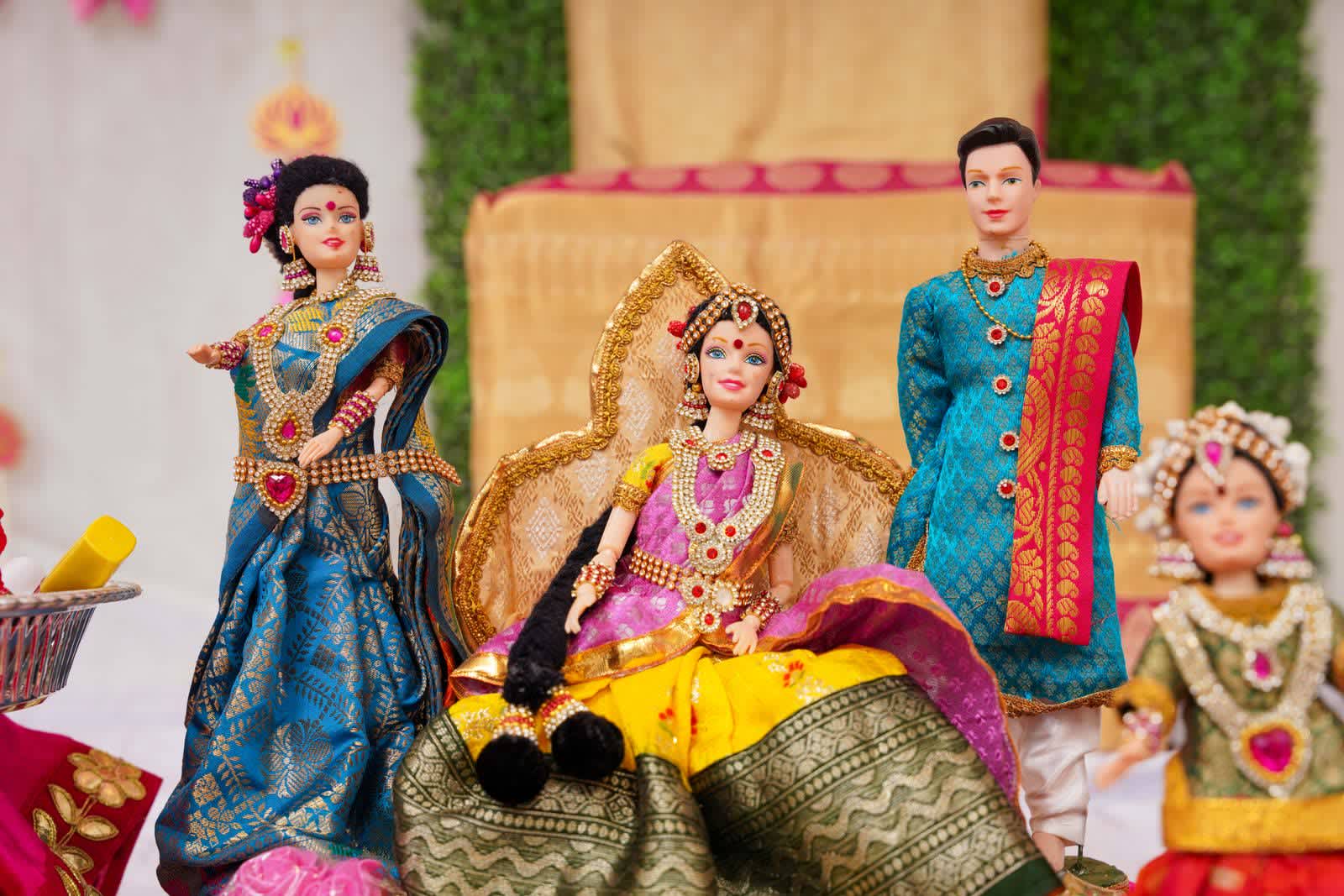
In Chennai the first sign of Navratri is not music. It is the sound of a plank being dragged out from behind a cupboard, and the particular smell of newspaper that has been wrapped around clay for eleven months.
Sharada Navratri in 2026 runs from Sunday 11 October to Monday 19 October, with Vijayadashami on Tuesday 20 October. The golu goes up on the first day and comes down on Vijayadashami. What happens in between is often described as a doll display, which is true and also misses the thing entirely. A golu has a grammar. Each step means something, the sequence from top to bottom is an argument about the world, and once you can read it the whole arrangement stops looking decorative.
This is how it is built.
1. Decide how many steps, and make them odd
Three, five, seven, nine or eleven. The number is always odd, in every house that keeps a golu, whether in Mylapore or in a two-bedroom flat in New Jersey. Households explain the rule differently — some say the odd number leaves the top step single and undivided, some tie nine steps to the nine nights, some simply say it has always been so. The explanations vary; the rule does not.
Choose by the height of your room and the size of your collection, not by ambition. Five steps well filled reads far better than nine with gaps.
The frame itself is plain carpentry. Wooden planks laid on trestles or on stacked stools, each tier set back a little from the one below so that everything on the lower steps stays visible. Many families now use collapsible metal or PVC stands. What matters is that the structure does not wobble — you will be reaching over it with a lit lamp for nine evenings — and that the deepest, heaviest planks are at the bottom.
2. Dress the steps before anything goes on them
Cover the whole structure in cloth, pulled tight and tucked under at the back so no plank edge shows. White was the old convention, usually a folded veshti pressed into service; coloured silk and printed cotton are now just as common.
Tuck, do not drape. A cloth that sags under a doll's base will tip it forward by day three. If you are using a slippery synthetic, put a strip of paper or thin rubber matting under the heavier pieces.
3. Set the kalasam first, on the top step
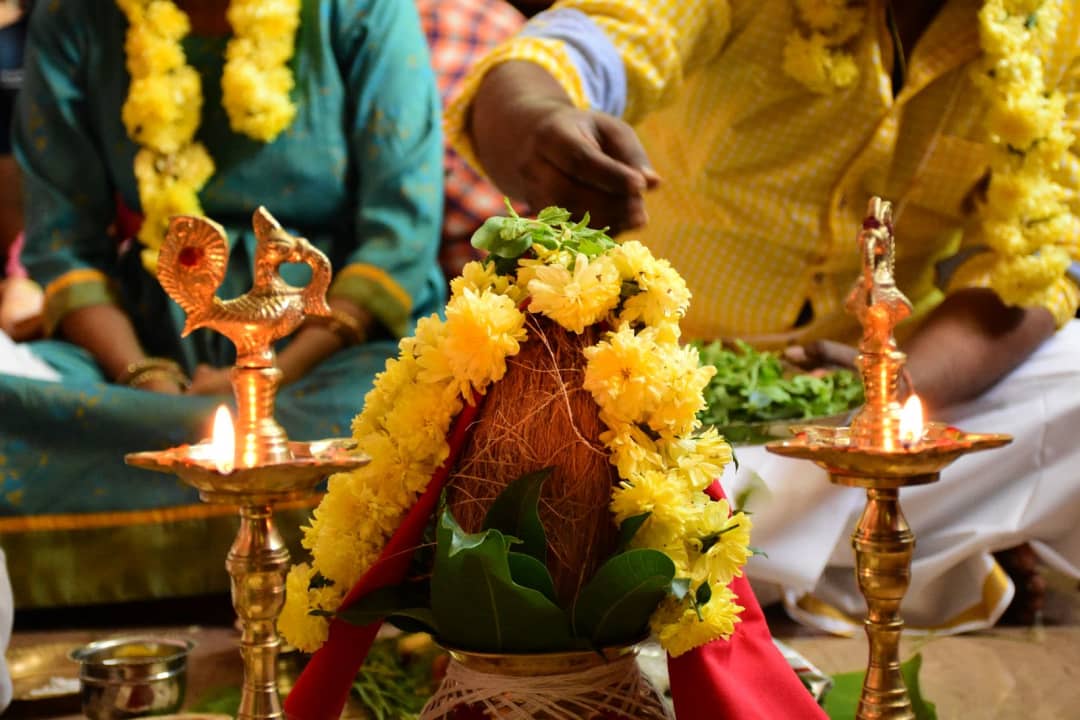
Before a single doll is placed, the kalasam goes up. This is what makes the arrangement a puja rather than a shelf.
A brass or silver pot is filled with water, mango leaves are set around the rim, and a coconut is placed on top, the tuft facing up. A new cloth is wound around the pot. In many Tamil households the kalasam is then given a face — eyes and a nose marked on the front, a small chain or garland added — so that it is quite clearly someone sitting at the top of the steps rather than something standing there.
The kalasam is invoked with a short puja on the first morning, and from that moment the golu is considered occupied. Everything placed afterwards is placed in front of a presence, not on furniture. This is also why the kalasam is the last thing touched when the display comes down.
4. Fill the steps from the top down
The arrangement descends from the divine to the ordinary, and it is worth following deliberately rather than by whatever fits.
- Top step: deities. The family's own — Lakshmi, Saraswati, Durga, Murugan, Venkatesa Perumal, whoever the house keeps.
- Second: saints, acharyas, the poets. Andal, the Alvars, Meera, Ramana Maharshi. Figures who are venerated but not worshipped as gods.
- Third: kings, queens, scenes from the epics. A Dashavatara set. A Krishna Leela row.
- Fourth and fifth: human life, in all its ordinariness. The wedding set, with its seated couple and its miniature garlands. The Chettiar shop — a shopkeeper behind his sacks of grain with a tiny pair of scales, still the most quietly beloved set in most collections.
- Lower steps: animals, birds, trees.
Somewhere on the upper-middle steps, if the house has them, stand the marapachi bommai — a pair of wooden dolls, a man and a woman, carved from hardwood and traditionally given to a daughter at her wedding. They are the seed of the collection. They are dressed afresh each year in scraps of the family's own cloth, which is why in a lot of houses they are the least impressive and most guarded objects on the steps.
5. Give the floor to the world
The ground in front of the bottom step is not leftover space. It is where the park goes: a mirror laid flat for a pond, cotton wool clouds, sand, small plants in eggshells, a set of tiny cattle. Children are usually handed this section outright, and it shows, which is the correct outcome.
Theme sets built here have become the display's running commentary — a village fair, a railway station, a harvest, sometimes a model of a temple the family has recently visited. Nobody minds that these sit below the gods. That is precisely where the world belongs in this arrangement.
6. Light it, and keep the evening the same each day

Two lamps at the base of the steps, lit at dusk, every one of the nine evenings. Electric string lights along the tiers are fine and now nearly universal, but they do not replace the oil lamps.
Scent is part of the hour rather than an accessory to it. Sambrani in the evening is the South Indian habit, though a stick lit at the base of the steps does the same work and burns unattended more safely around a floor full of clay; the hand-rolled agarbatti still made in Samastipur comes in the sandalwood and jasmine that suit a golu room better than anything sharp.
Keep the evening short and identical: light the lamps, light the sambrani or the stick, a song, the sundal handed round. Nine days of the same fifteen minutes is the entire practice.
7. Cook a different sundal every day
One legume a day, boiled, tempered with mustard seed, curry leaf and coconut — chana, black chana, green gram, peanut, cowpea, moong, white peas. It is offered at the golu first and then given to everyone who comes.
Visitors are sent home with thamboolam: betel leaves and areca nut, turmeric, kumkum, a fruit or a coconut, often a small mirror or comb or a blouse piece, and that day's sundal. In most houses the girls and women who visit are asked to sing something before they are handed it. This is the part of the golu that is genuinely social — the display exists so that people come and see it, and so that they are fed when they do.
8. Saraswati Puja: the ninth day belongs to books
The books go down on Tuesday 20 October in 2026 — notebooks, instruments and the tools of the household's work, set at the foot of the golu and left there. Nothing is read or played until they are lifted again.
That is the Tamil golu reckoning, which ties the rite to the ninth tithi and wants it standing at sunrise. Navami opens at 10:51 on the Monday and closes at 12:50 on the Tuesday, so Tuesday is the qualifying morning. Monday 19 October takes the eastern Navami rites and Saraswati Visarjan, closing the nakshatra-counted sequence instead — Avahan Friday 16 October, puja Saturday 17 October. Both are kept; the golu follows the tithi.
Dashami comes in at 12:50 that afternoon, so 20 October is Ayudha Puja and the golu's Saraswati Puja — one occasion in Tamil Nadu — and Vijayadashami as well. They come back up once Dashami has begun, that afternoon rather than the next morning, and the resumption is itself the rite: the hour held right for beginning anything. Kerala waits for Dashami at sunrise and keeps the pause a night longer — Wednesday 21 October, Vidyarambham.
9. Put it away deliberately
On the evening of Vijayadashami the lamps are lit a final time, the last sundal is distributed, and then one doll — commonly one of the marapachi pair — is laid down on its side. That gesture is the golu being put to sleep. Only after it is everything else lifted off.
Wrap each piece in newspaper and then in cloth, heads padded separately, and keep the clay figures out of any cupboard that catches damp during the rains; the paint lifts before the clay ever cracks. The kalasam water is poured at the base of a plant. The planks go back behind the cupboard.
Then the room is just a room again, for eleven months, and somebody in it is already deciding what to add next year.


