
Incense Ash: How to Read What a Stick Leaves Behind

There is a small chore that comes with burning incense in a flat. Once or twice a week you tip a little grey heap off the holder into the bin, wipe the sill with your thumb, and forget about it. It takes four seconds. I have come to think those are the most informative four seconds in the whole business.
Here is the position I want to defend, because I think it changes how you shop. Everything you know about a stick before you light it was written by somebody who would like you to buy it: the fragrance name, the words on the box, the burn time printed on the back. The ash is the only statement the stick makes about itself. It is unedited, it costs nothing, and it turns up whether you asked for it or not. In a one-room flat where you might burn one stick a day by the window, that free second opinion is worth having.
What the grey heap actually is
Ash is the part of the stick that was never going to burn — the mineral fraction, left standing after everything combustible has gone up as smoke and gas.
Researchers who have run Indian incense-stick ash through X-ray fluorescence find it is dominated by calcium: around 49% calcium oxide, roughly 20% silica, and about 8% potassium oxide, with smaller amounts of alumina, iron oxide, magnesia and phosphates. One review summarises the material as 50–60% calcium and magnesium oxides, 15–25% carbon, 15–20% silica, and 5–8% iron oxides and alumina.
Read that carbon figure again, because it is the one that surprised me. Up to a quarter of what you sweep off the sill is not mineral at all. It is fuel that never finished burning.
Why there is anything left at all
A stick does not burn the way a candle does. It smoulders, and smouldering is a genuinely different process: the slow, flameless form of combustion sustained by heat released when oxygen attacks the surface of a solid fuel directly. The reaction happens on the surface of the solid rather than in the gas phase above it, and it creeps along at something like 0.1 mm per second — roughly ten times slower than a flame spreads over the same material. Typical incense burns somewhere between 220 and 260 °C. By the standards of fire, that is barely trying.
Smouldering is incomplete combustion, and it leaves a significant amount of solid residue behind. That sounds like a flaw. It is actually the entire design.
A flame would be hot enough to destroy the aromatic compounds you paid for before they ever reached the air. The whole craft of an incense stick is keeping the reaction slow enough and cool enough to volatilise the fragrance rather than incinerate it. You want the combustion to be incomplete. The ash is the physical proof that it was.

The first reading: how fast it went
This is the one I would start with, because it needs no expertise at all — only a clock.
Direct-burning incense needs two things in the paste: a fuel, usually charcoal or wood powder, and an oxidiser such as sodium nitrate or potassium nitrate to sustain the burn. Getting that ratio right is the difficult part of the recipe. Too little oxidiser and the stick will not stay lit. Too much and, in the standard formulation guidance, the incense burns too quickly without producing fragrant smoke.
That last clause is the whole argument in seven words. A stick that races is not a generous stick. It is a stick carrying too much saltpetre, and speed is being bought with the thing you actually wanted. If a pack claims forty-five minutes and you are tipping ash out after twenty, you have learned something concrete about the paste — and if you want to understand why the black base under the fragrance matters so much to that ratio, it is worth a separate look.
There is a neat confirmation hiding in the chemistry, too. That 8% potassium oxide in the ash is, in part, the potassium nitrate coming back out the other end. The oxidiser leaves a receipt.
The second reading: colour and crumble
Watch what the ash does structurally as the stick burns down.
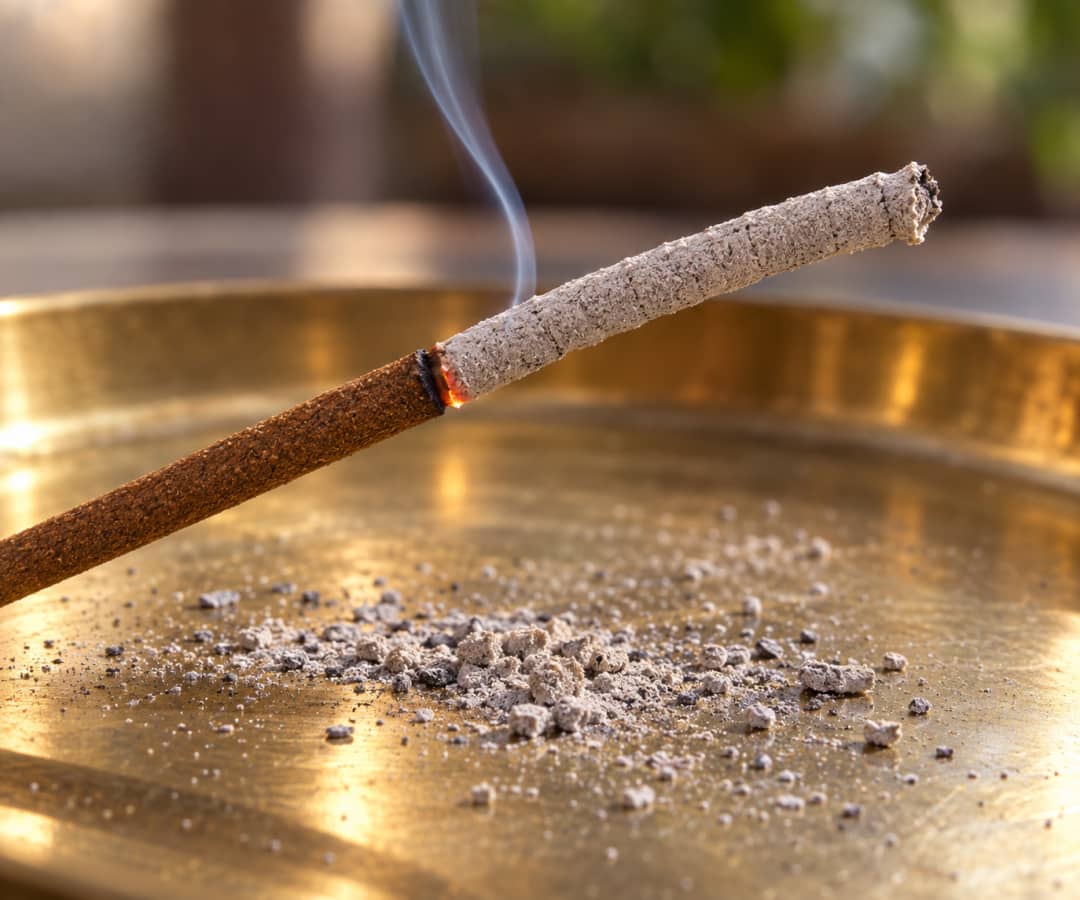
Good ash tends to hold its shape. It keeps the cylinder of the stick for a surprising distance, grey and firm, before gravity takes it. That cohesion comes from the binder — the gum that holds the paste onto the bamboo, typically around 10% of the dry weight of the finished stick. A paste that is properly bound and evenly rolled chars into a coherent column rather than falling apart in flakes.
Ash that drops dark, oily flakes, or a stick that keeps going out and needs relighting, is telling you the fuel underneath was wrong — too much cheap filler, too little binder, or a paste that dried unevenly before it ever reached you. Pale, firm, consistent ash is not a guarantee of a beautiful fragrance. But it is a reliable sign that somebody controlled the build.
What the ash will not tell you
I should be honest about the limits of my own argument, because they are real.
The ash is a test of construction, not of perfume. It will tell you whether the stick was built with care and burned at a sensible rate. It will tell you nothing whatsoever about whether the sandalwood is sandalwood, whether the oil was good, or whether you will like the smell in a small room at nine at night. A beautifully engineered stick can carry a thin, synthetic fragrance, and I have met several that did.
So the ash is not a verdict. It is one honest input among several, and it happens to be the only one that is free and the only one the seller does not write. For the rest, you are still reading the pack — and which words on a label carry real information is a different skill, worth learning separately.
The standard, and the test you can run
India now has a formal specification for this. In December 2025, the Bureau of Indian Standards released IS 19412:2025, Incense Sticks (Agarbatti) — Specification, launched on National Consumer Day at Bharat Mandapam in Delhi. It sorts agarbatti into three categories — machine-made, hand-made and traditional masala — and sets requirements for raw materials, burning quality, fragrance performance and chemical safety. It also names substances that may not be used, including the insecticidal compounds alethrin, permethrin, cypermethrin, deltamethrin and fipronil, and synthetic fragrance intermediates such as benzyl cyanide, ethyl acrylate and diphenylamine.
That is a serious and overdue piece of work, and it is the right way to regulate an industry this large. But notice what it is: a laboratory protocol, run by somebody else, on a sample you will never see. I could not find published numerical thresholds for ash content in the public summaries, and in any case you cannot run a nitrate assay on a windowsill in Dadar.
The windowsill test is cruder and it is yours. Light the stick. Note the time. Watch whether the ash holds its column or flakes away. See how much of it there is, and what colour. Where we roll incense in Samastipur, this is roughly what gets done to a batch before anyone writes anything on a box — the slow ones are the good ones, and the ash says so first.
One last thing about the heap
The ash does not vanish when you tip it. At scale it is a real material: ash from temples and households across India is collected in significant quantities, and because it is considered sacred a great deal of it goes into rivers rather than the bin. There is now a small research literature on recovering the calcium, silica and iron from it and turning it into something useful.
That is a problem well above the size of your windowsill. But it did change how I look at the heap. It is not nothing, and it is not waste in the ordinary sense. It is the mineral skeleton of something you lit on purpose, and for four seconds a week it will tell you the truth about what you lit.
Look at it before you tip it.


