
Kantha: Straight Answers About Bengal's Old Quilts
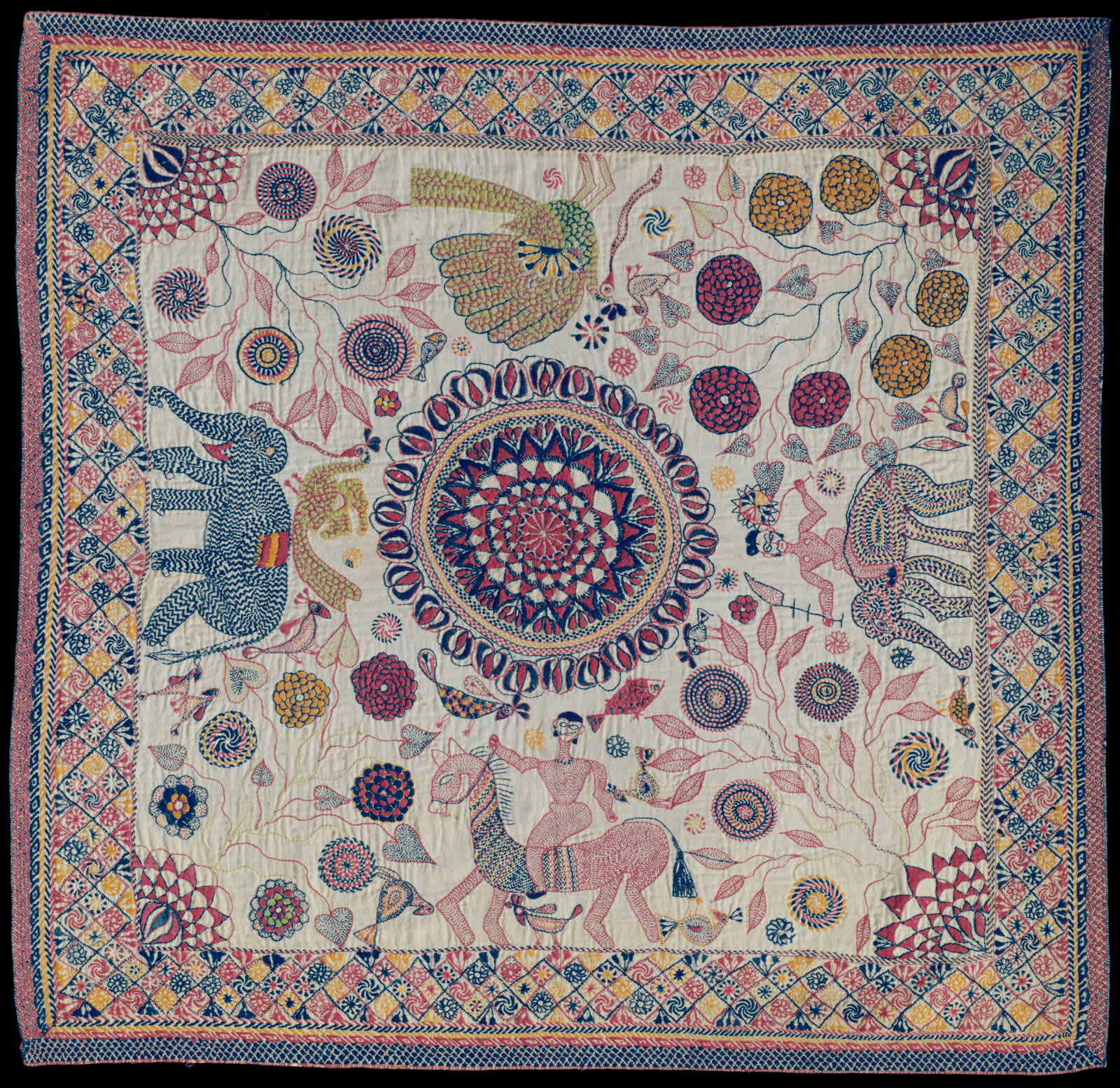
People ask me about kantha more often than about anything else here, and the questions are usually better than the answers they have been given. I am not an embroiderer. I have never finished one, and the two in my family's almirah were made by women I never met. What I have is years of asking. Here is what I have.
What is a kantha, exactly?
Not embroidery on new cloth. A kantha is several worn cotton saris or dhotis laid flat on one another and held together by a running stitch — the plain in-and-out stitch, the first one anybody learns — worked in rows across the whole surface. Four or five layers for a light wrap, more for a winter quilt. The stitching is the structure and the decoration at the same time; there is nothing underneath doing the real work. That is the entire technique. Everything anyone admires in a kantha is what that one stitch does when it is repeated for a year.
Then what is a nakshi kantha?
Naksha means design, so a nakshi kantha is a figured one — a kantha carrying a picture rather than plain rows. The term travelled beyond Bengal after 1929, when Jasimuddin published a narrative poem called Nakshi Kanthar Math, the field of the embroidered quilt, in which the quilt outlasts the lovers Rupai and Saju. Shops now use the two words interchangeably. That is not quite wrong, but if a seller says nakshi they are promising you figures, and you are entitled to go looking for them.
Why old cloth? Was it only poverty?
Partly, and there is no need to be delicate about that. But worn cotton is also the better material. It is soft, it takes a needle without arguing, and three thin layers fall around a body in a way one thick new layer never will. A new sari is a poor kantha. There is also what the cloth was before — a wedding sari, a father's dhoti — which is why so many were made for a particular person, and why almost none were made to sell.
Where did the thread come from?
This is the fact that changes how you look at one. The thread was drawn out of the coloured borders of those same worn saris and dhotis, unpicked strand by strand and stitched back into the cloth it came from. It explains the narrowness of the old palette: red, black and blue on an off-white ground, over and over. Nobody chose that restraint for its elegance. It was what the borders happened to hold. A kantha is a cloth drawing itself in its own thread, and I have never quite got over it.
Is there only one kind of kantha?
The classification usually quoted runs to seven, sorted by size and job rather than by pattern. A lep is the thick winter quilt. A sujni is the large rectangular spread brought out on ceremonial days. A bayton is a square wrap for books and valuables. An arshilata wraps a mirror and comb, an oaar covers a pillow, a durjani or thalia is a small square whose corners fold into the middle like an envelope, and a rumal is a handkerchief. The quilt is simply the one that got famous.
Why is there so often a lotus in the middle?
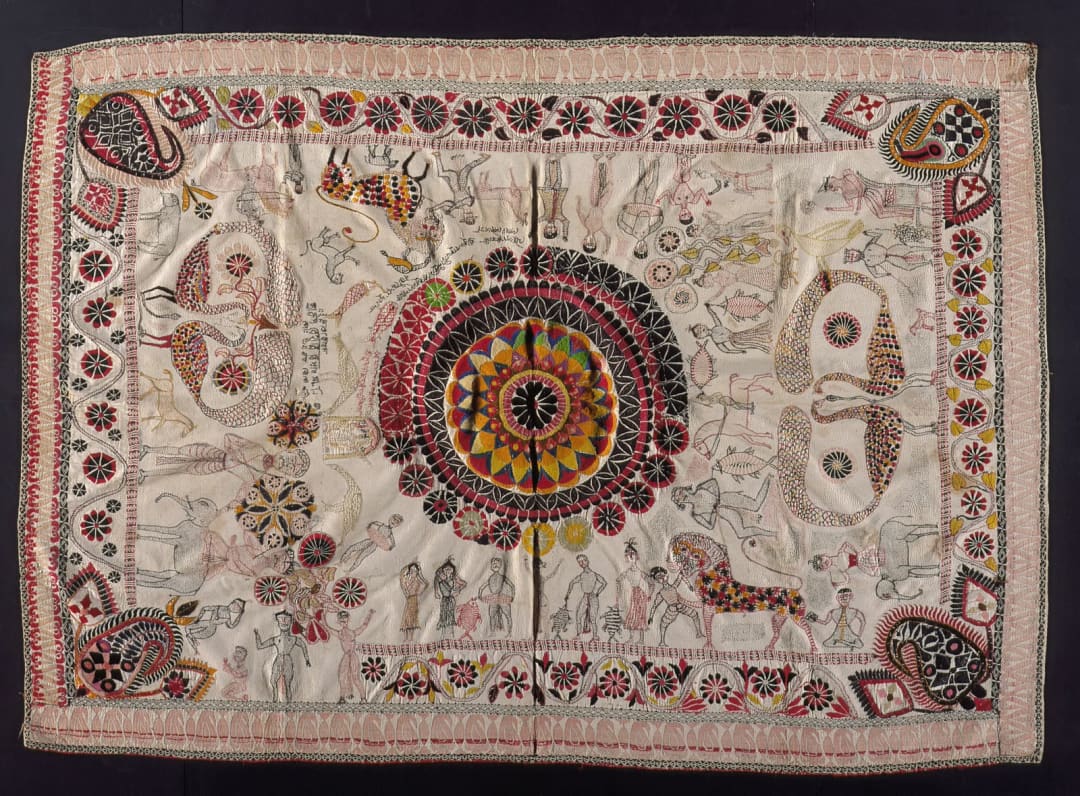
Because the middle is what gets decided first, and once it is settled the rest of the field can be filled in over months without a plan. The lotus is the commonest centre by a long way, usually with a kalka — the paisley form — in each of the four corners. Whether it carries a meaning or is simply the shape that opens outwards in every direction depends on who you ask. Household drawing traditions elsewhere in eastern India work the same way, as the women who draw aripan in Mithila will tell you: the centre first, then outward, then whatever time allows.

What is actually on the old ones?
Everything the household could see. The Gurusaday Museum in Kolkata holds a double-sided sujni from Khulna, nineteenth century, made by Manadasundari Dasya of Jangal Badhal — one of the very few makers whose name we have at all. On it are the inner and outer quarters of a house, a hunting scene, wild animals, impossible flowers, motor cars, Indian soldiers carrying bayonets and British soldiers carrying swords. It is not folklore. It is a woman putting down her century as it passed her window, and it is better reporting than most of what was printed at the time.
How old is the tradition, honestly?
Here the honest answer is that nobody can say. The word appears in medieval Bengali writing, and people reasonably take that as evidence of a long tradition. But the oldest kanthas that physically survive date from the early 1800s, and no earlier — layered cotton in this climate does not last, and a quilt that is used gets used until it is gone. So the tradition is certainly older than its objects, and by how much is a guess. Be suspicious of anyone who gives you a founding century with confidence.
Is kantha Indian or Bangladeshi?
Both, and the paperwork now says so twice. Nakshi kantha was registered as a geographical indication in India in 2008, tied to Birbhum district — which is where I live. Bangladesh registered the nakshi kantha of Jamalpur under its own law on 25 April 2024. The line of 1947 ran straight through the tradition: much of the finest old work, and most of what Gurusaday Dutt collected in the 1930s, comes from districts now in Bangladesh. Two registries, one stitch. I am not going to adjudicate it and would distrust anyone who did.
Is the kantha-stitch sari in the shops the real thing?
It is a real thing, just a different one. What is sold as a kantha-stitch sari is a new sari embroidered with the kantha running stitch — the stitch borrowed and applied as surface decoration. There is no layering, no old cloth, no quilt. That trade grew out of twentieth-century revival work, including the rural crafts programme Rabindranath Tagore set up at Sriniketan in 1922, and it keeps a great many women in paid work. Buy one happily. Just do not think you have bought a kantha.
Is stitching one a form of meditation?
I would be careful with that. Women stitched kanthas in the gaps of long days, often for years, usually because the household needed a quilt and there was no money for one. Calling that meditation flatters us and tidies them away. What is true, and quite different, is that repetitive handwork holds attention in a steady way that many people find settling — you hear the same thing from anyone who rolls incense by hand for a living. That is a description of the work. It was never the reason for it.
How do you look after an old one?
Gently and rarely. Never dry-clean it; the old thread and the older dyes will not survive the solvents. Wash by hand in cold water, no detergent worth the name, and dry it flat and out of the sun, because the red will move and it will move onto the white. Do not iron the ripple out. That pucker is the running stitch pulling the layers together and it is the evidence that the thing is handmade. Store it folded loosely, refolded along different lines now and then, with air around it.
What should I look at first?
The back. On a good kantha the reverse is nearly as composed as the front, and on the double-sided ones it is a second picture entirely. Then find the place where the stitching changes its mind — the rows tighten, or the colour shifts because one spool of unpicked thread ran out. That is where the maker stopped for a season and came back. Nobody designs that in. It is the closest you will get to standing next to her.


