
Sabarimala Vratham: The 41 Days Before Anyone Leaves

Almost everything written about Sabarimala is about the last two days of it. The forest path up from Pamba, the eighteen steps, the few seconds in front of the shrine. That is the photograph, and it is a good photograph. It is not the pilgrimage. The pilgrimage, by the plain arithmetic of the thing, is forty-one days long, and forty of those days happen in an ordinary house a long way from Kerala, with the washing on the line and the office to get to.
The season is measured in one unit, and the unit is forty-one days
This year the Mandala season opens on Tuesday 17 November 2026 — the day-panchang prints Mandala Pooja Begins against that date — and the Mandala Pooja itself falls on Sunday 27 December.
Count the days between them, inclusive. Fourteen in November, twenty-seven in December. Forty-one.
That is not a coincidence and it is not a round number somebody liked. A mandalam is a period of forty-one days. Kerala Tourism's own account of the pilgrimage uses the word twice over for two different things: the Mandala kaalam, the forty-one-day season the temple keeps, and the Mandala Vratham, which it defines as "the observance of austerity that stretches across a period of 41 days before embarking on the pilgrimage."
Same word, same count, applied once to a calendar and once to a person.
The temple's year does not stop there — the doors keep a longer cycle that carries on past the Mandala Pooja to the Makaravilakku festival in the new year, around sixty days in all with a short break in the middle. But forty-one is the figure that organises everything. And the useful thing about it is that one person can hold it. A season you can only read about is a schedule. A season that is exactly as long as the thing it asks of you is a different object entirely.
The day it starts, and the person who has to be standing there
The vratham does not begin when you decide it begins.
It begins when somebody puts a mala — a string of tulsi or rudraksha beads — around your neck. And that somebody is not you. By custom the mala comes from a temple priest or from a guruswami, which in this tradition means a devotee who has made the Sabarimala journey, by the usual reckoning, eighteen times or more.
This is the most interesting structural fact in the whole observance, and you do not have to believe anything to find it interesting. The start is witnessed. You cannot quietly begin forty-one days on a Monday because you woke up feeling resolute, and you cannot quietly stop on the Thursday. Someone with eighteen seasons behind them has agreed that you are beginning, and from that morning you are wearing the evidence around your neck where every person you meet can see it.
First-timers have their own word — kanni swami — and it is the guruswami who walks them through what follows.
What the forty-one days actually ask
The list is shorter than people expect:
- Black. Kerala Tourism puts the reason plainly: pilgrims "dress themselves in black, denoting detachment from material things." Dark blue and saffron are also worn.
- No haircutting, no shaving, no trimming of nails for the whole period.
- A vegetarian diet, and celibacy.
- A cold bath twice a day, morning and evening.
- Sleeping on a mat or on the floor, not on a bed.
- Bare feet. For forty-one days, not only on the hill.
- Everyone is Swami. Pilgrims address each other by that single name, and the stated intent is that they set aside social and economic distinctions and treat one another as equals for the duration.
Now read the list again and notice where every item on it takes place. Not one of them happens at a temple. They happen in a bathroom before dawn, on a bedroom floor, in a kitchen, and in whatever room you work in, where you turn up unshaven and in black for six weeks and have to explain yourself to people who did not ask.
This is the half that English-language coverage skips almost entirely, and it is odd that it does, because it is the only half most people would ever have access to. Our own archive is no better: we have written about the Kanwar yatra walk from Sultanganj to Deoghar and about the six-day Tamil fast that ends in the spear-throw at Tiruchendur, and in both cases what we described was the road and the rite at the end of it. Nobody writes the Tuesday in the fourth week.
The bundle nobody arrives without
On the eve of the journey there is a ceremony called kettunira, and what it produces is the irumudi kettu — a cloth bag with two compartments, carried on the head.
The front compartment, the munmudi, holds the offerings and the puja items meant for the shrine. The back, the pinmudi, holds the pilgrim's own provisions for the road. Into the front goes the item everyone photographs without quite knowing what it is: a coconut with its water drained out and ghee poured in to fill the hollow. Kerala Tourism gives the reading attached to it — the draining out of worldly pleasures and the replacing of them with spiritual thoughts. Where there is a group, the filling is traditionally begun by the kanni swami, the first-timer; where there are several, by the youngest of them.
Then the rule that makes the bundle non-negotiable. In the words of the state's own description of the rituals: "No devotee without Irumudi kettu is permitted to climb the 18 holy steps to the shrine."
Which produces a quietly strange arrangement, and it is worth saying out loud. The forty-one days issue no certificate. Nothing at the gate can check whether you slept on the floor in the third week or ate what you should not have in the fifth. What the gate checks is the bundle — a physical object, packed the night before, in front of other people. The austerity is unverifiable and the luggage is not.
What a deadline does that a resolution cannot
It is tempting, from a distance, to read the forty-one days as a very old version of the thirty-day challenge, and the comparison is worth making only because of how badly it fails.
A private streak has a start you chose, a rule you wrote, and an ending that is the number itself. This has none of the three. The start is handed to you by someone else. The rule is fixed and nobody consults you about it. And the ending is not day forty-one — the ending is a place, several hundred kilometres away, which you have to physically travel to and climb. The count does not finish the thing. The count qualifies you to begin it.
I would not pretend that any of this transfers. It belongs to one tradition, one deity and one hill, and a six-week austerity kept for a journey is not a wellness programme and was never designed as one. But the architecture is instructive even if the content is not yours: a beginning somebody else has to witness, a marker you cannot take off, and a finish line that is somewhere rather than some number.
What it does not promise
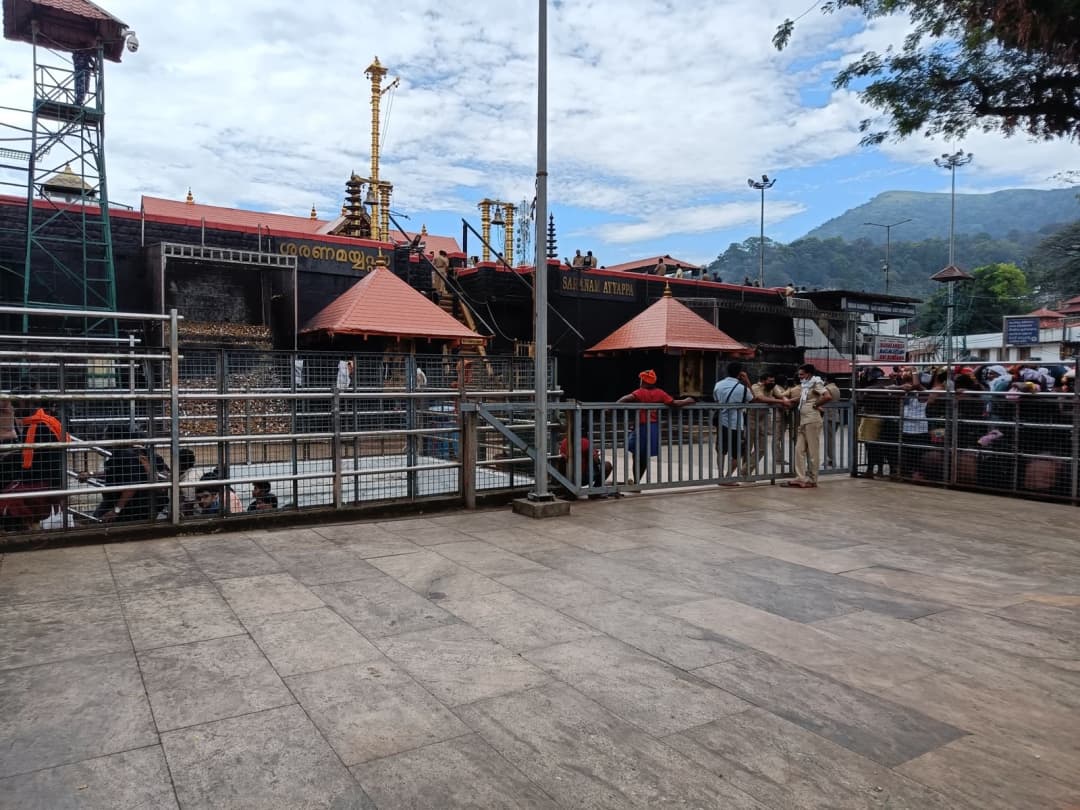
Kerala Tourism calls Sabarimala one of the largest annual pilgrimage sites in the world and puts the figure at ten to fifteen million people a year. At that scale the arrival is necessarily managed — steel barriers, a channelled queue, police standing at the rail, and your few seconds at the front of it.
Nothing about the forty-one days guarantees you a better few seconds. That is not what they are for, and anyone who tells you otherwise is selling something. The days before are simply the part of the pilgrimage that cannot be crowd-controlled, scheduled or shortened, because they take place in a house where only the household can see them — which may be the only reason they have survived at all.


