
Skanda Sashti and the Soora Samharam at Tiruchendur
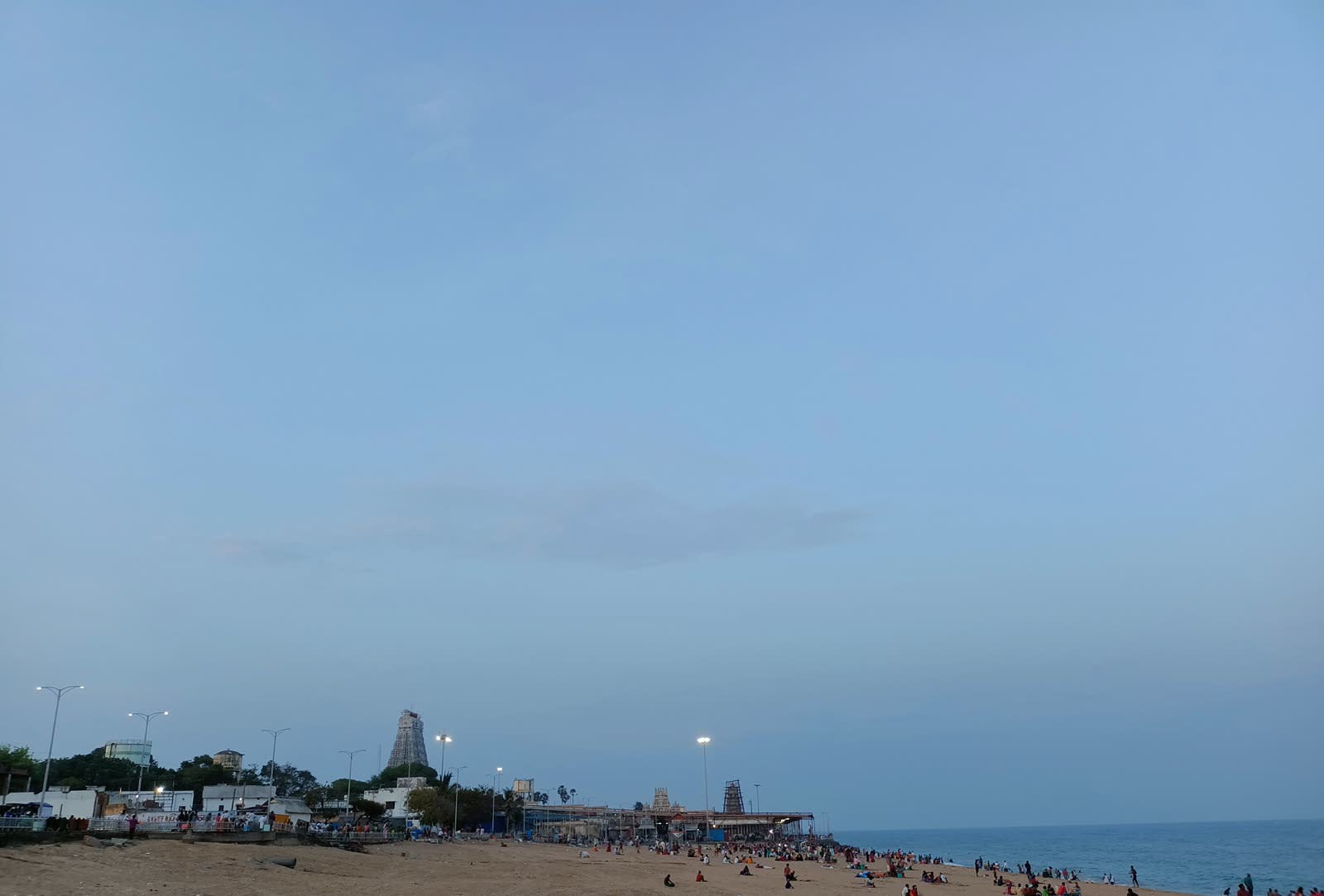
Every year, on a stretch of sand in the far south of Tamil Nadu, several thousand people gather to watch a fight whose outcome they have known since childhood. A painted figure is carried out — blue face, tusks, an enormous moustache, a crown. A spear is thrown. The figure comes apart. Everyone goes home.
Nobody arrives at a story like that hoping to be surprised. They come for the part that is hard to keep hold of the rest of the year, and here that part is not the killing. It is what happens to the loser afterwards.
The day is Skanda Sashti. In 2026 it falls on Sunday 15 November, and the six days of fasting that lead up to it begin on Tuesday 10 November — the morning after Diwali's new moon has finished.
A boon that named the thing that would undo it
The fullest Tamil telling is the Kanda Puranam, a medieval rendering of the older Sanskrit Skanda Purana. It opens, as these stories often do, with somebody getting exactly what they asked for.
Three asura brothers — Surapadman, Simhamukhan and Tarakasuran — performed severe austerities to Shiva, and Shiva granted them weapons and a wish. They did not ask to live forever. They asked for something cleverer: that they could be killed only by a son of Shiva. At the time, Shiva had no son. They had written a death warrant and left the name blank, confident nobody would ever fill it in.
So they took the three worlds and held them, and the devas eventually went to Shiva to complain about a situation Shiva had personally authorised.
What the boon had done was not protect them. It had named, in advance, the one thing in creation that could end them — and then obliged the universe to produce it.
The child who was assembled
Murugan is born into that gap. Six sparks come from Shiva and become six boys, raised by the Krittikas, the cluster of stars; Parvati gathers them into one child with six faces. The Sanskrit name Kartikeya means "of the Krittikas" — he is named for the women who brought him up rather than for either parent.
His mother gives him the vel, the spear, understood as her own power in the shape of a weapon. He is made commander of the army of the devas while still, in most tellings and in most images, a boy.
In the north he tends to be met as Shiva's other son, the brother of Ganesha — more talked about than worshipped. In Tamil country he is Murugan, and he is nobody's supporting character: he appears in Sangam poetry as the god of the hill country long before the Tamil Murugan and the Sanskrit Skanda were understood as one deity.
Six days, and what they are actually counting
The fast runs for six tithis, from Pratipada — the first day of the waxing fortnight — through to Shashthi, the sixth. In 2026 those fall tidily on 10, 11, 12, 13, 14 and 15 November, one tithi to each sunrise, which is not something you can count on: tithis stretch and collapse against the solar day, and in other years the six days and six dates do not line up so neatly.
Worth noticing where that first day lands. The same Pratipada that opens the fast in the Tamil south is Govardhan Puja in the north and Bestu Varas in Gujarat — the day-by-day calendar of the Diwali week has it as the morning the year turns over for a Gujarati trading house. One tithi, three unrelated things, depending on where in the country you wake up.
The tradition gives two reasons for six days rather than any other number, and they point in opposite directions. In one, the devas prayed to Murugan for six days before the fighting started. In the other, Murugan himself kept six days of observance, seeking his father's blessing before he went. Either way the fast re-enacts not the battle but the waiting beforehand — the part of any war nobody makes pictures of.
In houses that keep it, the six mornings have a texture of their own — an early bath, a lamp, and the slow smoke of sambrani before the puja shelf while it is still dark outside.
The flight, and the mango tree
The sixth day is the fighting, and the Kanda Puranam gives Murugan his two brothers first — Tarakasuran and Simhamukhan — before Surapadman is left alone on the shore at Tiruchendur.
Here the story stops behaving like a battle and starts behaving like a chase. Surapadman takes an enormous form, many-headed and many-armed, to frighten the boy in front of him. It does not work. When the vel is thrown he does not stand and take it: he escapes into the sea and turns himself into a mango tree so vast it spreads across all three worlds.
It is a strange, memorable image — the last stand of a tyrant is to become a tree and try to be too large to kill. The vel follows him in and splits the tree down the middle.
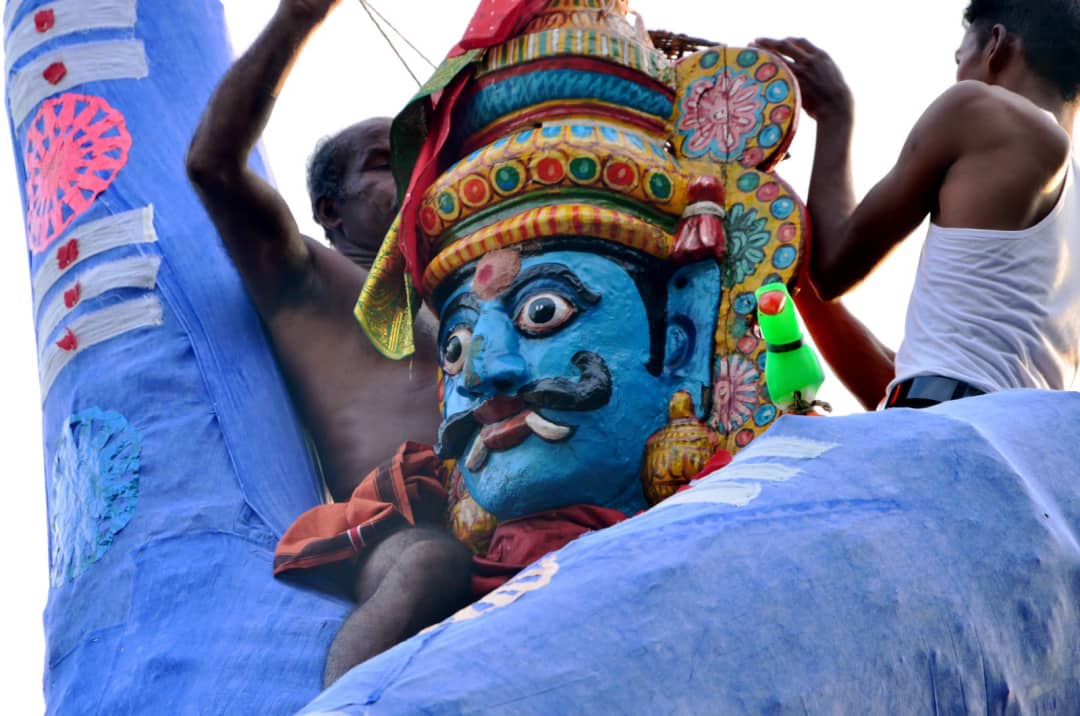
That splitting is what the crowd has come to see. The re-enactment is called the Soora Samharam, and it is kept at Murugan temples across Tamil Nadu — Tiruchendur, one of the six principal abodes, is simply the most famous place to see it, because it is where the story says it happened.
What the two halves became
And then the ending, which is the reason to tell this story at all.
The two halves of the split tree do not vanish. One becomes a peacock, and Murugan takes it as his mount. The other becomes a rooster, and he sets it on his banner.
The enemy is not erased. He is enlisted. The god spends the rest of time carried by one half of the creature he defeated, under a flag bearing the other half — visibly, in every icon, every procession, every calendar print hanging in a shop. Once you have been told, you cannot look at an image of Murugan without noticing that Surapadman is in it twice.
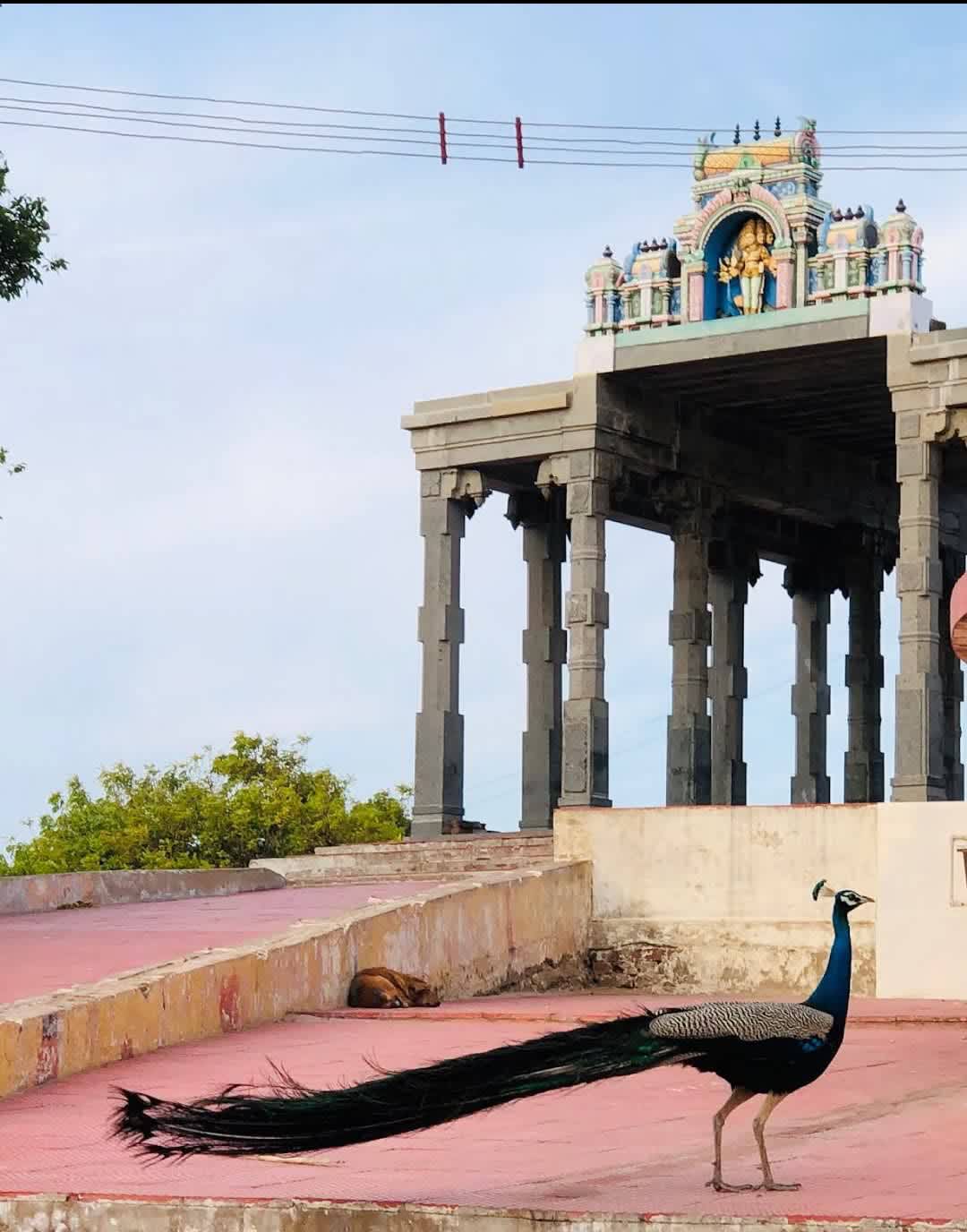
What the tradition does with that is quieter than a moral. The asura asked to be killed only by Shiva's son, and in the asking he came close enough to Shiva to be remade rather than simply ended. Being defeated by the right opponent turns out to be a kind of destination.
The armour you put on first
The hymn recited through the six days is the Kanda Sashti Kavacham, composed in the nineteenth century by Devaraya Swamigal at the Murugan temple in Chennimalai, in what is now Erode district.
A kavacham is an armour, and the hymn is built like one. Its long middle section works down the body, asking protection for the parts in turn; later lines ask for safety from poisonous creatures, from sickness, from the fear of dying badly. It is a battle hymn handed to a householder — the war in it is not on an ancient beach but in an ordinary week.
Most people who know it by heart learned it from the Soolamangalam Sisters' recording, which has been playing out of temple loudspeakers and kitchen radios for decades.
The shore itself
The temple at Tiruchendur sits on the sea in Thoothukudi district, at the eastern edge of the town, its nine-tier gopuram standing about 157 feet. Unusually for a large Tamil temple the principal entrance faces south, and the innermost sanctum is a cave. The image in it is Murugan not as a commander but as a child. A little to the south is the Nali Kinaru, a well fed by a freshwater spring almost within reach of the surf, where pilgrims rinse after bathing in the sea.
The place has had a secular history too. The Dutch East India Company held the temple from 1646 to 1648 during their war with the Portuguese, and were put out on the orders of the Nayak ruler Thirumalai Nayak. On the way they took two processional images of Murugan, then dropped them into the sea when the weather turned; the images were recovered in 1653 by a man named Vadamalaiyappa Pillai. The episode is painted on the walls inside the complex — of everything that has happened at a temple this old, the story kept on the wall is the one about the god being taken away and brought back.
On the evening of the sixth day none of that is visible. There is a crowd on the sand, a figure being carried out, and a spear, and then the long walk home in the dark with the sea on one side — and somewhere above the gate, a peacock that used to be somebody.


