
Sanjhi: The Sixteen Days of Flowers on a Cow-Dung Wall
The smell I associate with the fortnight of the ancestors is not sandalwood or camphor. It is fresh cow dung in a steel bowl at five in the evening, still warm, with water worked into it until it went slack enough to spread.
My grandmother would hand me the bowl at the door and go back inside. That was the whole of the instruction. The wall was mine.
What went on the wall
Sanjhi — we said Sanjha, and elsewhere in Rajasthan it is Sanjhaphuli or Sanjhya — is a relief made on a wall out of cow dung and then decorated. You smear a patch of wall smooth, usually a corner of the dalan where everyone passing has to see it, and while it is still wet you draw into it with your fingers, raising thin ridges.
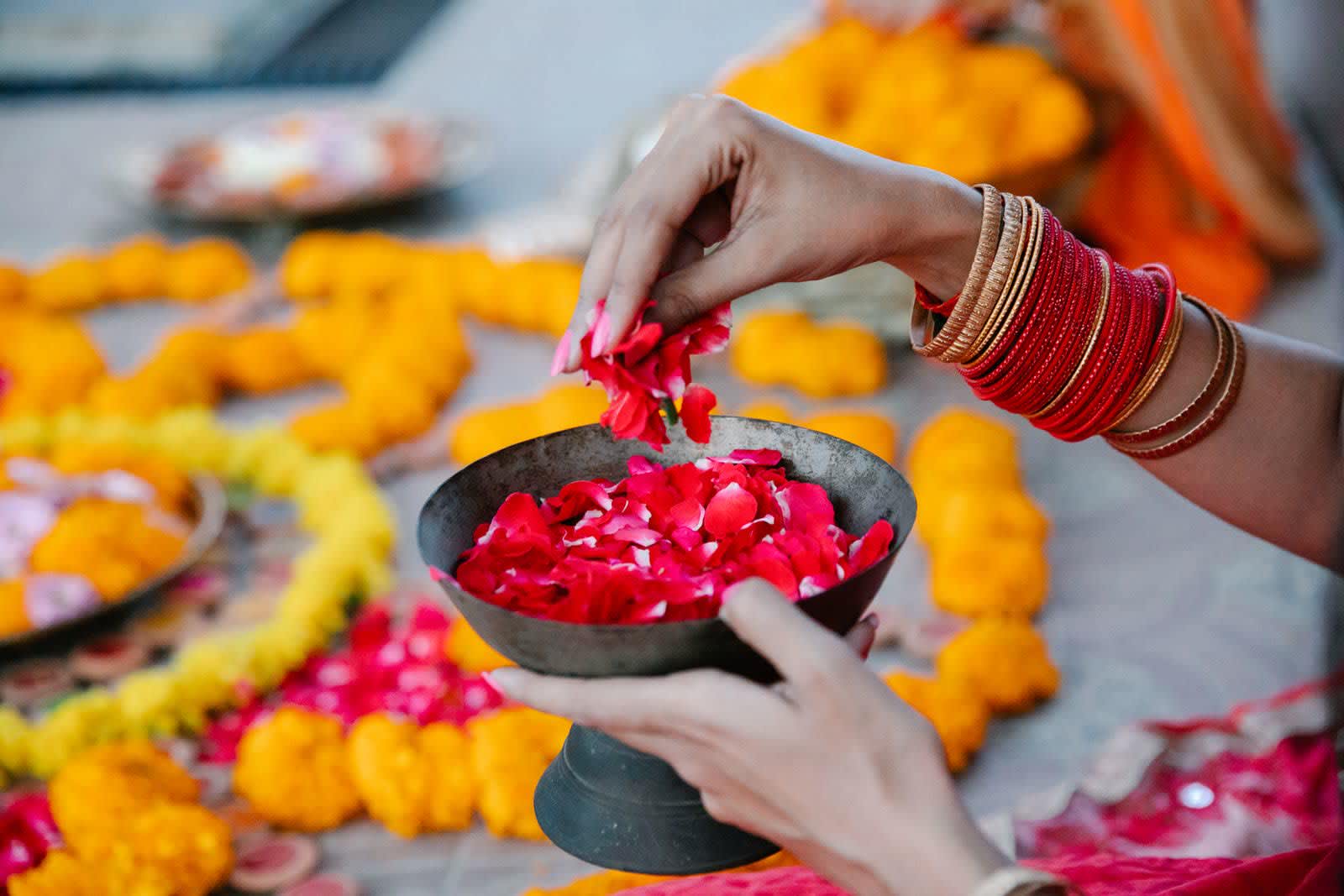
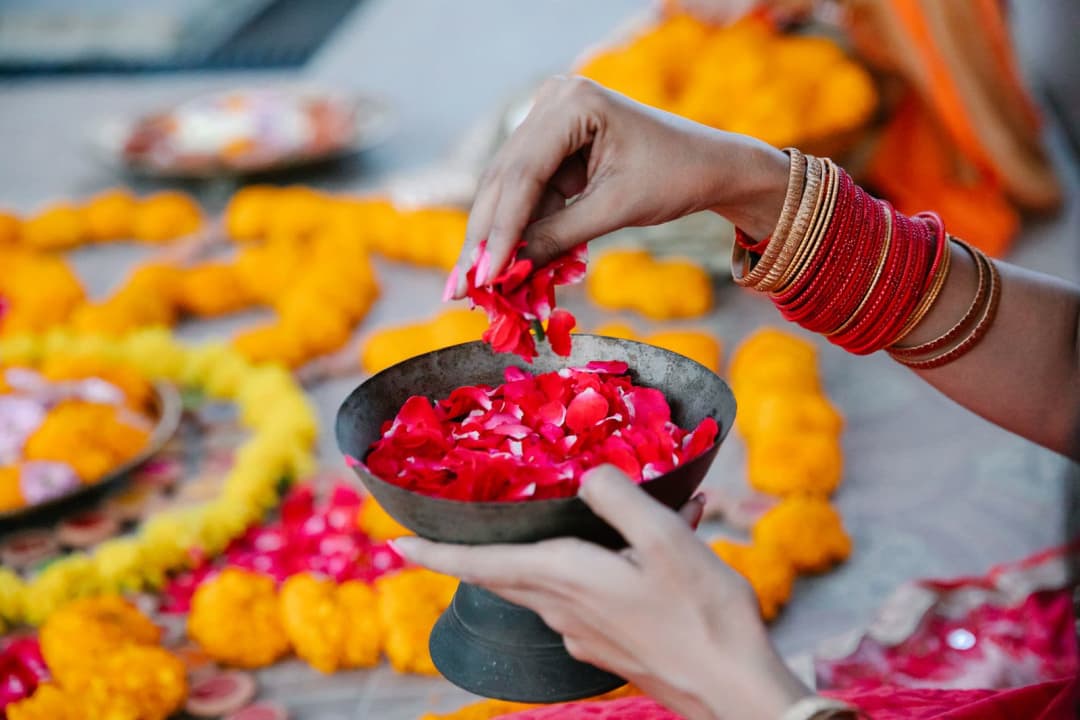
Then you press flowers into the ridges. Marigold mostly, because it is what there is at that time of year and its petals come away in useful flat pieces. Gulbas, which opens in the evening anyway. Turmeric and kumkum for what had to be yellow or red, and for the ambitious, foil off a mithai box.
Cow dung starts drying the moment it touches brick; there is no second chance.
One shape a day, for sixteen days
The sequence I remember most clearly, because it was recited at me before I could make any of it.
The full moon gets a patla, a low wooden seat. The first day of the waning moon, a chhabdi, a basket. Then a bijora, a citron. On the third, a ghevar — which in Jaipur is a small joke you feel before you understand it, because you are drawing in cow dung the honeycomb disc the halwai had stopped stacking in his window a month earlier, when Teej ended.
Then the fourth day's moon. Five bowls on the fifth, a six-petalled flower on the sixth, a satiya on the seventh, a bandanwar on the eighth. A drum on the ninth, a lamp on the tenth, a carpet on the eleventh, a fan on the twelfth.
From the thirteenth evening to the last, no more single objects. You build the killa kot — the fort.
The lists do not agree, and I think I can see why
I went looking later for a printed version of the sequence I was taught. The printed versions do not match each other. One account from Malwa puts the basket on the sixth day rather than the first, and fills the middle of the fortnight with things I was never given — a chaupad board, five bachelors, an old couple, a banana tree, a pair of peacocks or of jalebis.
I am not going to referee that. Say the sequence I was taught aloud: chauth ka chand, panchami ka paanch katora, chhat ki chhah pankhudi, saptami ka satiya. Four days running, the shape is simply the number of the day, rhymed into it. That is a list built to be held by a nine-year-old and carried to another house at marriage, not one copied from a book. A thing built that way drifts, and the drift is not damage.
Every version agrees on the full moon at the start, the fort at the end, and sixteen of them.
The songs were not devotional
This surprises people who expect a girls' observance to sound like a bhajan. The Sanjhi songs are teasing songs, about Sanjha herself — arriving in a little cart with her ghagra swinging, being grand about her father's house, demanding things. One goes back and forth about the dung itself: Sanjha asks for fresh green dung, and the answer is a shrug — where am I to bring it from, sister?
At the end of each evening a lamp is lit in front of her and the women come out for a short aarti, quiet and proper, with the day's incense already burning at the tulsi. Then it goes straight back to teasing.
Nobody has ever told me who she is
I have been given three answers and they cannot all be right.
The first is that she is Parvati, and the girls are asking for a husband like the one Parvati got. That is the version printed most often. The second is that she is a daughter of the house who was married away, come home for sixteen days — which is why she is teased like a sister rather than addressed like a goddess. The third, heard only from families further east, is that she is a brahmin's daughter betrothed to Tesu whose father keeps delaying the wedding, and the shapes are what she makes while she waits.
The second is the one that does something to me, because the fortnight it sits inside is the fortnight the men of the house spend feeding people who have died. The same sixteen days. One half of the house is receiving guests who return annually and cannot stay; the other half is receiving a girl who has come home and cannot stay. Nobody in my family said this out loud and I have no source for it, so take it as something I noticed rather than something I was told.
The fort, and the crow
The killa kot is everything at once: four evenings of work, the whole wall, the previous twelve shapes set into it, and around them a fort with walls and gates, a sun and a moon.
And a crow. The crow is not optional — every account agrees, and so does everyone I have asked.
It is also the one piece that gets removed. Before sunrise on the last morning somebody takes the crow off the wall, because — and this is said seriously, with a straight face — if he is left up all night beside her he will become fond of Sanjhi and want to marry her.
Consider what that means. The crow is the bird the other half of the fortnight is entirely about, the one the ancestors are understood to come and eat as. Put on a wall of flowers by a group of girls, the same bird becomes an unsuitable young man to be got rid of before anyone wakes up.
The sixteenth evening
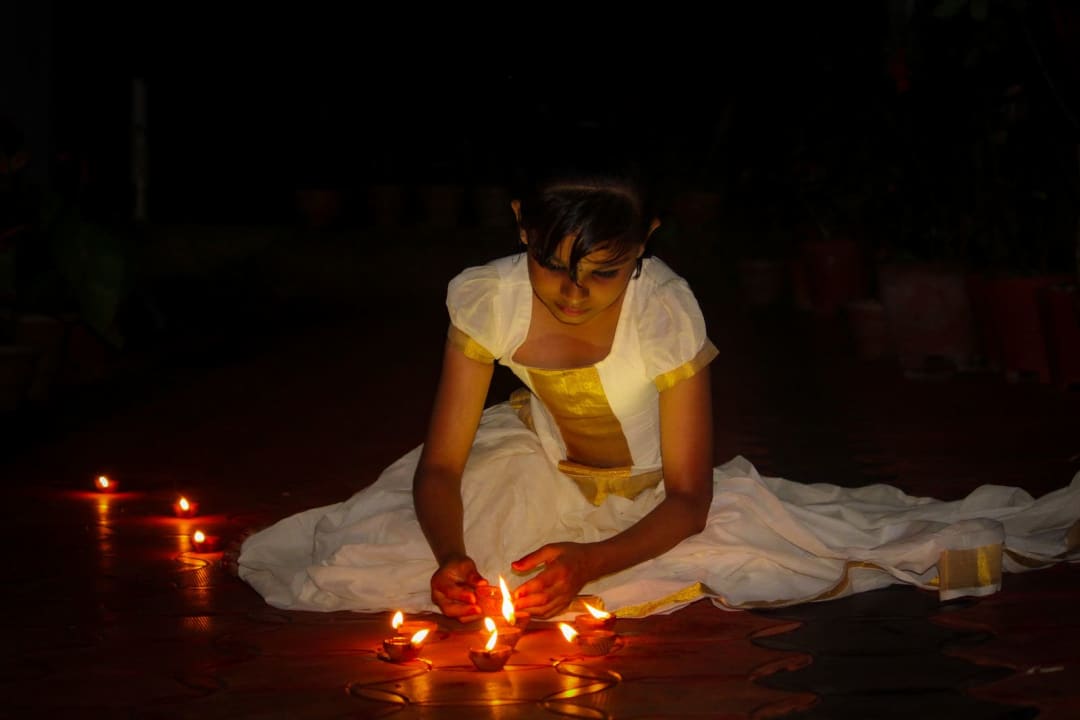
On the new moon she is taken down. The dung is lifted off the wall into an earthen pot, a lamp is set in front of it, and the girls sing her out — songs that have turned into instructions to leave before her people come looking. Then the pot goes to water.
There is raw milk, and kumkum, and kasar. The prasad is cucumber and dry coconut, cut up and handed round, and I have never once eaten cucumber off a steel plate in the dark without thinking of it.
The other Sanjhi
There is a second thing with this name and it runs on the same fortnight. In the temples of Braj — Radharaman, Radhavallabh, Bhattji ki Haveli — Sanjhi is a high art. Dry colours are sifted through paper stencils cut fine enough to be transparent, and in the form called jal sanjhi the powder is tapped through muslin onto standing water, where the picture floats until it is let go. There Sanjhi is understood as Radha; in the villages around, as Parvati.
Two traditions, one name, one fortnight, and about as far apart in skill and status as two things can be. I have not seen anyone explain the relation.
What is left of it
Less every year, for a reason that has nothing to do with belief: the walls are gone. Cow dung does not go onto painted cement in a flat. Where it survives it has moved onto board or paper, which keeps the shapes and loses what I actually remember — that it was on the house, and everybody in the lane walked past it.
I should say plainly that I have not made one since I was about fourteen, that I never built a killa kot without three other people, and that I am not a scholar of any of this. The printed accounts I have read, I read this month, and they mostly disagreed with my grandmother.
What I would keep is the crow. Sixteen days of the year the country is careful and formal with its dead, and in the same sixteen days a group of girls builds a fort out of dung and flowers, puts the bird of the dead on top of it, and takes him down at dawn for being too interested.


