
Sohrai Painting: How a Jharkhand Mud Wall Is Painted
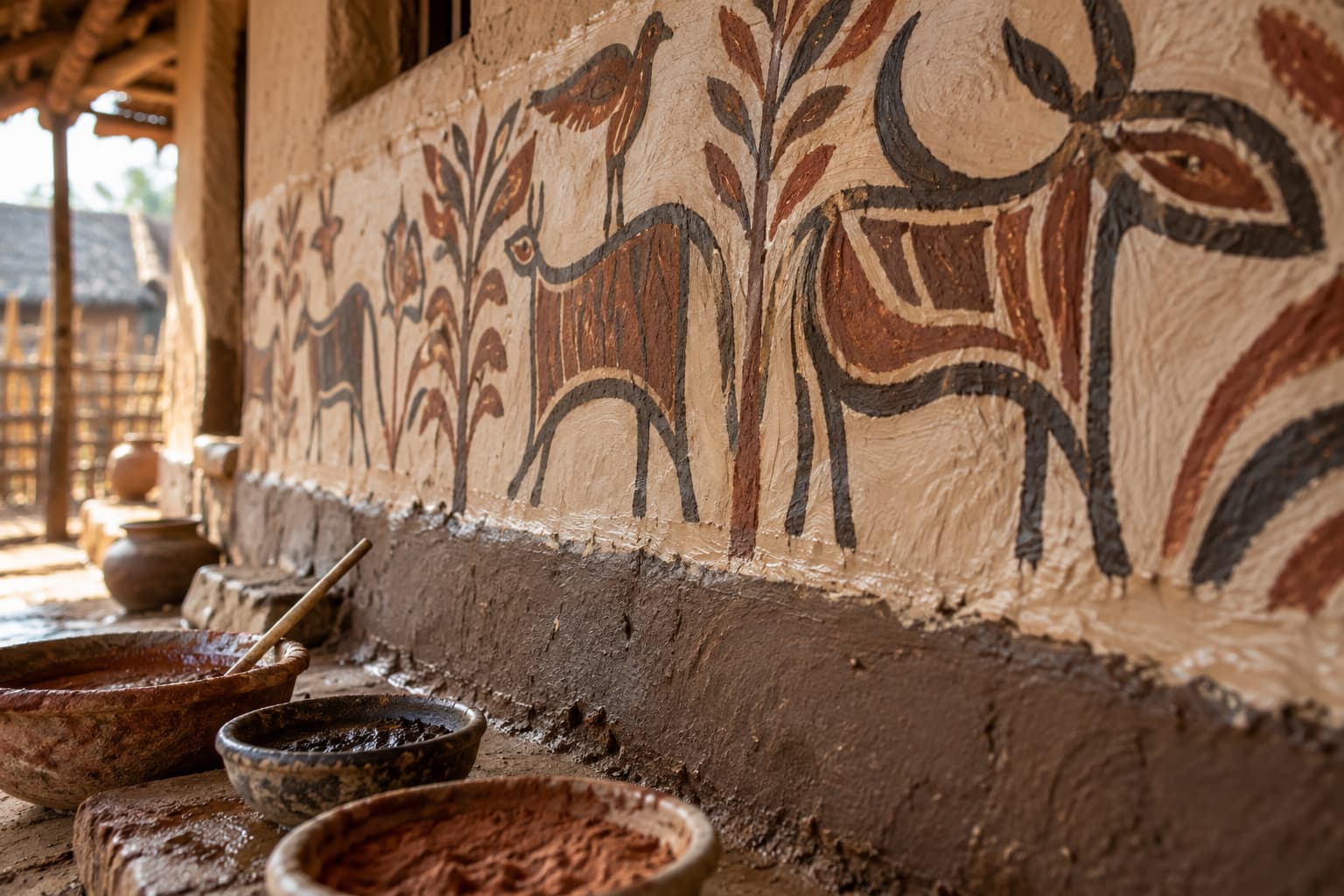
A Sohrai wall is painted in layers, out of the same earth the house is built from. The mud surface is sealed with cow dung, given a coat of pale clay, and the design goes on before that coat dries. Its sister form, Khovar, uses the identical wall and reverses the method entirely — there the picture is scraped out rather than painted on.
Key takeaways
- Sohrai is additive. Lines of red, black and white earth are laid onto a pale clay ground with cloth swabs, chewed sal twigs and the cut end of a broom.
- Khovar is subtractive. Black clay goes down first, white clay over it, and a comb takes the white away while it is still damp to uncover the black underneath.
- The paint and the wall are the same material — local clays on a dung-and-earth plaster — which is why the work weathers off and is renewed each year rather than conserved.
- Sohrai belongs to the cattle festival at the Kartik new moon; Khovar belongs to the wedding season. Sohrai-Khovar painting received a Geographical Indication tag in 2020.
What is Sohrai, and how is it different from Khovar?
They are two uses of one wall. A house in a Hazaribagh village may carry Khovar from a wedding in the spring and Sohrai from the cattle days after Diwali, and the two will look nothing alike, because the hand did opposite things.
Sohrai honours Pashupati, the lord of animals, and arrives with the festival of the same name — the cattle festival that closes the farming year across the plateau's calendar. Khovar honours the Devi and belongs to marriage; the word is usually read as the bridal chamber itself.
| Sohrai | Khovar | |
|---|---|---|
| Method | Painted on | Scraped out (sgraffito) |
| Ground | Pale clay over dung plaster | Black clay, then white clay over it |
| Tool | Cloth swab, chewed sal twig, broom end | A broken comb, or four fingers |
| Timing | The three days at the Kartik new moon, after Diwali | The marriage season, after the monsoon |
| Honours | Pashupati, lord of animals | The Devi |
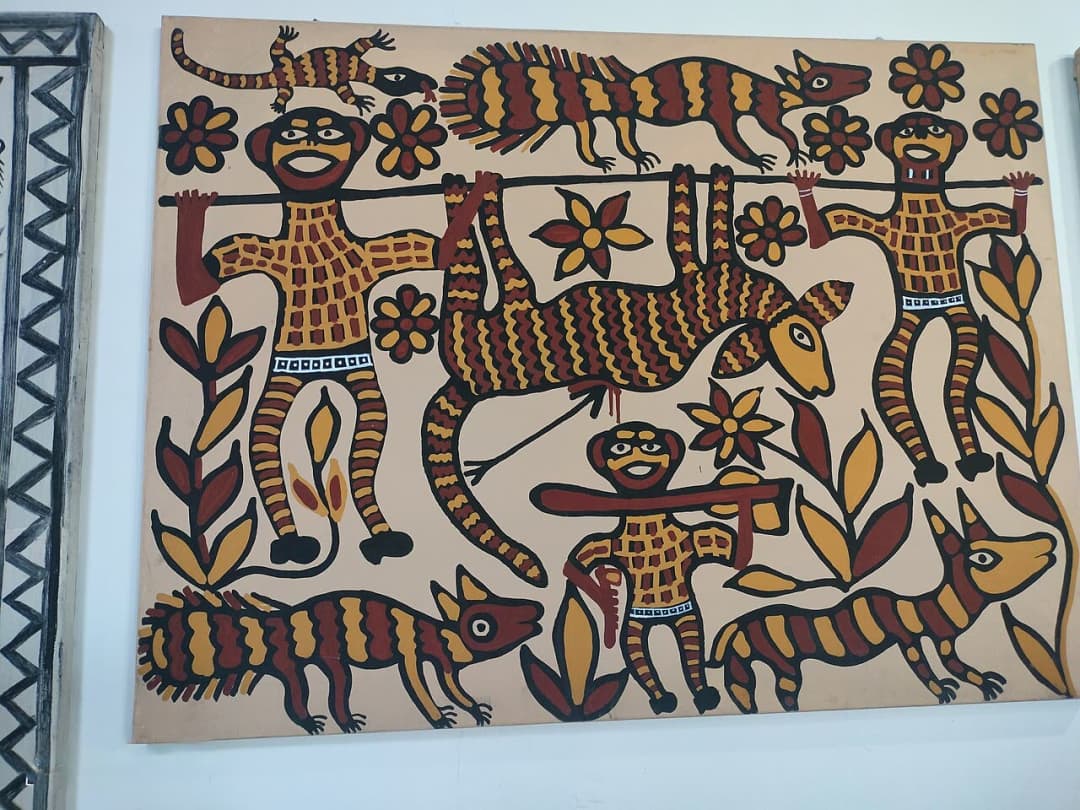
| Typical motifs | Hens and chicks, humped cattle, buffalo, tiger, wild pig, nilgai | Bamboo, elephant, turtle, peacock, lotus |
What do you need before a line is drawn?
Very little that has to be bought. The earths are foraged in the hills or picked up in a village shop: a manganese-rich clay that dries almost black, a white or cream kaolin, and red, orange and yellow oxides. Cow dung and sieved soil make the plaster. The brushes are improvised and disposable — a rag wound into a swab, a sal twig chewed until the fibres splay, a few straws pulled from a broom.
That chewed sal twig is worth pausing on. It comes off the same sal forest that gives the plateau its dhuna resin, and it is made in seconds by a painter who will throw it away that evening. The tradition carries no specialist equipment at all.
How is a Sohrai wall painted, step by step?
- Repair the wall. Cracks from the monsoon are filled and the surface is made true. This is building work, and it is done first.
- Seal it. Sieved soil and cow dung are spread over the whole surface and left to firm up. It binds, it seals, and it gives everything above a key to hold on to.
- Lay the pale ground. A coat of white or cream clay goes over the plaster. The painting happens while this is partly dry — not wet enough to run, not dry enough to refuse the pigment.
- Draw the red lines first. Red is the ancestors and fertility, and it sets out the skeleton of the design.
- Add the black. Black is read as Shiva, and it is the line that gives the figures their edge and their weight.
- Finish in white. White stands for food, and it is the last thing laid down — highlights, dots, the filling of the fields between the other lines.
- Leave it. Nothing is sealed, varnished or fixed. The rain is part of the plan.
The order matters more than the drawing. A painter who puts black down before red cannot recover the design, because none of these earths is opaque enough to cover a mistake.
How does Khovar take the picture out instead of putting it in?
This is why the two forms look so different on the same house.
A layer of black earth is applied to the mud wall and left to dry. A second layer of white earth goes over it, hiding it completely. Then, before the white has set, the painter drags a broken comb through it — and the design appears as black, because she is removing the pale clay that was covering it.
So the dark line is never drawn. It was already there, under the white, waiting. The painter is not adding an image to a surface; she is taking a surface away to find one. Everything hangs on the window while the top layer is still damp: too early and the white smears back into the groove, too late and it will not lift at all. The clock is as much a tool as the comb. The Wikipedia account of Sohrai and Khovar painting records the layers being read as womb and seed, with the comb raising the Mother Goddess out of them.
Which animals appear, and why?
Mostly the ones the household depends on or fears. Hens and chicks are the commonest motif of all; after them come the animals of the yard and the animals of the forest, in the same frame. Khovar leans the other way, and the pregnant peacock is held to be the most auspicious thing a bride's wall can carry.
For a festival that exists to thank the cattle, painting the cattle onto the house is not decoration. It is the same gesture as washing the bullocks and anointing their horns with vermilion in oil, done in a different medium.
When does the wall get painted?
| Season | What is painted | Where |
|---|---|---|
| After Diwali, at the Kartik new moon — in 2026 that moon falls on Sunday 8 November | Sohrai, over three days | Most of the Chotanagpur plateau |
| 10th to 15th January | Sohrai, kept later | Santal Parganas |
| The marriage months after the rains | Khovar | Hazaribagh and around |
The January dating is not anyone's mistake. Santal Parganas keeps the festival at its own time, and a visitor reading a single-line calendar will arrive in the wrong month.
Why is it repainted every year?
Because it cannot be kept. Clay on dung plaster, under monsoon rain, has one season in it. The wall fades, the lines soften, and the next year the women of the house put it back — so the skill has to be handed on every single year or it is gone, and that yearly repetition is what has carried it from mother to daughter with no school or manual anywhere in the chain.
Since the early 1990s, after the work around Isco village in Barkagaon block drew attention to it, the same painters have also worked on paper and board, which is how most people outside the region first see it. Those panels are real Sohrai by every measure but one: they can be hung and kept. The wall version cannot, and was never meant to be.
A painted house in Hazaribagh in late November is not a preserved thing. It is a wall that has been made fit for the year ahead, with the animals that earned it drawn across the front, and it will be gone by the next rains.
Questions people ask
What is Sohrai painting?
A mural tradition of the Chotanagpur plateau, centred on Hazaribagh district in Jharkhand, painted on the mud walls of village houses at the cattle festival after Diwali. It received a Geographical Indication tag in 2020.
What is the difference between Sohrai and Khovar?
Sohrai is additive — coloured earths are brushed onto a pale ground. Khovar is subtractive: black clay is covered with white, then combed away while wet so the black shows through. Sohrai belongs to the cattle season, Khovar to the marriage season.
What colours are used, and where do they come from?
Clays dug locally or bought in village shops — a manganese-rich clay for black, a white or cream kaolin, and red, orange and yellow oxides. Nothing in the palette is manufactured paint.


