
Srirangam Temple History: Exile, Return, Rebuilding
The queue at Tirumala teaches a particular kind of patience. You shuffle forward through a caged corridor for hours, and somewhere around the sixth hour you stop thinking about the darshan ahead and start noticing the hill itself — the worn granite underfoot, the cold that lifts off the rock once the sun drops.
It took me a long time to learn that this hill is supposed to have hidden somebody else's god.
For part of the fourteenth century, the processional image of Ranganatha — the reclining Vishnu of Srirangam, far to the south in the Kaveri delta — is recorded as having sheltered up here, away from his own sanctum, because there was nowhere safer. That single fact rearranged the way I think about Srirangam. It is the largest functioning Hindu temple complex in the world. And almost nothing about it is a monument to continuity. It is a record of interruption, and of people who came back and picked up the work.
The temple that is also a town
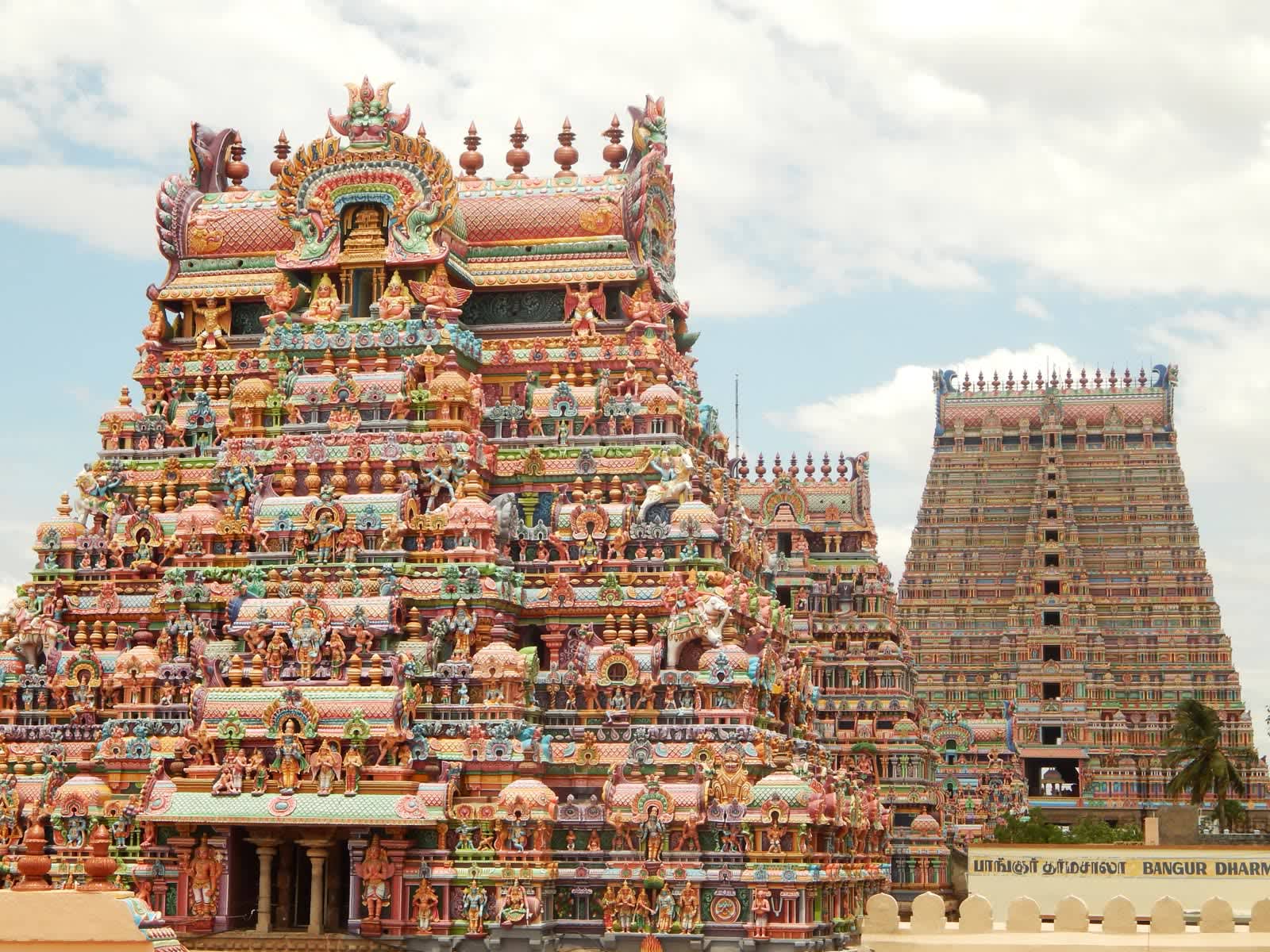
Srirangam stands on an island about twelve kilometres north of Tiruchirappalli, held between the Kaveri and the Kollidam. The complex covers sixty-three hectares — a hundred and fifty-five acres — arranged in seven concentric enclosures called prakarams, with twenty-one gopurams, eighty-one shrines and thirty-nine pavilions.
Those numbers do not prepare you for what actually surprises a first-time visitor. The outer two prakarams are not a heritage buffer or a ticketed approach. They are a living town. Houses, shops, restaurants, flower stalls, bicycles leaning on thousand-year-old stone. You pass a man selling tulsi garlands and a man selling phone chargers within the same twenty metres, and both of them are inside the temple.
This matters for the history, not just the atmosphere. A temple with a town inside its walls is a temple that can be besieged, occupied, emptied and resettled — and Srirangam has been all four. The enclosures are not decoration. They were the thing that had to be held.
What the walls remember
The temple town carries more than eight hundred inscriptions, of which roughly six hundred and forty are cut into the temple walls and its monuments. They run from the late ninth century through to the sixteenth, and they are not the work of one dynasty taking credit. Cholas, Pandyas, Hoysalas, Nayakas and the Vijayanagara rulers all left their record on the same stone.
I should say plainly that I have not read any of them. I cannot read Grantha, and I am not a historian — I am someone who stands in queues and reads what historians publish afterwards. But you do not need the script to understand the shape of the evidence. Eight hundred inscriptions across seven centuries, from five different ruling houses, is not the signature of a building. It is the signature of an institution that kept outliving its patrons.
The year the god left
Here the sources stop agreeing, and it is worth saying so rather than picking the tidiest version.
One account places a raid by Malik Kafur in 1311. Another describes a further invasion between 1323 and 1327 under Muhammad bin Tughluq, in which the processional image of Ranganatha was carried off towards Delhi. A third tradition dates the raid that forced the image out of the sanctum to 1331, when a band of devotees led by Pillai Lokacharya took it away to safety.
These are not variations on a detail. They are three different years for the central event in the temple's history, and the honest position is that the chronology is contested. What the accounts agree on is the substance: at some point in the first half of the fourteenth century, the sanctum at Srirangam was emptied, and the image that is carried in procession — the one people actually see — went on the road.
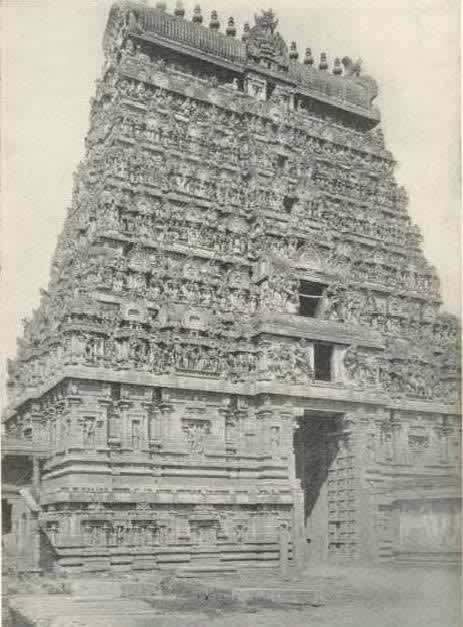
The temple also keeps a name from those years. The Vellai Gopuram, a nine-storey tower on the east side of the fourth enclosure rising to nearly forty-four metres, is said to be named for Vellayi, a temple dancer remembered as having died during the invasion. I cannot vouch for the history behind the tradition. I can only note that a building was named after her, and that the name stuck for six hundred years.
Decades on the road
Through roughly 1331 to 1371 — four decades, give or take the dating you accept — the Madurai Sultanate held authority over the temple, and Ranganatha was not in it.
The image moved. One of the places it is recorded as having rested is Tirumala, which is where this becomes personal for anyone who has climbed that hill. The god of the Kaveri plains spent part of his exile in the cold on a hill in the Seshachalam range, among a different temple's crowds.
The return came with a Vijayanagara commander named Gopanna, one of the leaders of Kumara Kampana's expedition of 1371 against the Madurai Sultanate. The inscriptions record that Gopanna brought the image down from the hills of Tirumala, kept and worshipped it for a time at his fortress at Gingee, and after the campaign succeeded, installed it again at Srirangam alongside Lakshmi and Bhudevi. The reconsecration is dated to the seventeenth of Vaikasi in the Saka year 1293 — the thirteenth of May, 1371.
There is something I find steadying in that date being so exact. The years of absence are argued over. The day of the return is written down.
The tower that waited four hundred years
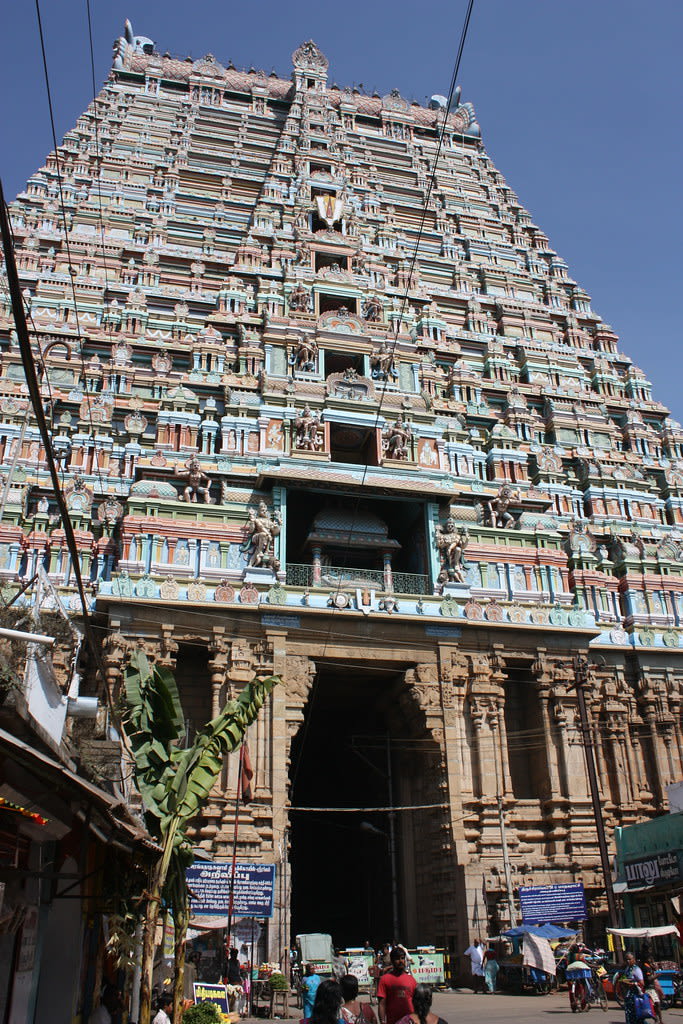
The best illustration of how Srirangam actually works is the Rajagopuram, the great tower at the outermost entrance.
Its base was laid during the Vijayanagara period, under the reign of Achyuta Deva Raya. Then the work stopped. The empire declined, patronage moved elsewhere, and the stump of the tower stood there — a plinth with no tower on it — for more than four hundred years. Generations of pilgrims walked past an unfinished building and thought nothing of it, because it had always been unfinished.
It was completed in the twentieth century. The Ahobila Matha took up the task, with the forty-fourth Jeeyar raising the donations, and the finished Rajagopuram was consecrated on the twenty-fifth of March, 1987. It stands seventy-three metres — about two hundred and forty feet — across thirteen tiers, and it is the tallest temple tower in Asia.
So the most imposing thing at Srirangam is younger than most of the people who stand under it. In 2017 the temple received the UNESCO Asia-Pacific Award of Merit for cultural heritage conservation, the first in Tamil Nadu to be given it — an award, in the end, for maintenance. For the unglamorous business of keeping a thing going.
The door that opens once
One more detail, and it is the one I would travel for.
On the northern side there is a gate called the Paramapada Vasal, the gate to Vaikuntha. It is opened on one day in the year, at Vaikuntha Ekadashi, which falls in the month of Dhanu, somewhere between the middle of December and the middle of January depending on the year. On that day the processional image is brought out through it to the thousand-pillared hall — a granite hall built, like so much else here, in the Vijayanagara period. Tradition holds that whoever passes through that gate reaches Vaikuntha, which is why it is also called the Svarga Vasal.
A gate that stays shut for three hundred and sixty-four days is a strange thing to build. But it fits the place. Srirangam has never behaved as though time runs evenly — four decades with the sanctum empty, four centuries with a tower half-built, and one morning a year when a door that leads nowhere the rest of the time leads straight to heaven.
What I take from it, standing in my own queue on my own hill, is that devotion here has mostly been measured in resumption. Somebody always came back. That is the part worth carrying home.


