
Brahma Temple, Pushkar: The God With Almost No Temples

Every list of the Hindu gods puts Brahma near the front, and almost no building puts him anywhere. He is the first of the three, the one who makes. Go looking for a place to actually stand in front of him and you will be handed one answer: a small town in Rajasthan about ten kilometres northwest of Ajmer, at roughly 510 metres, built around a semi-circular lake.
The reason usually given for that is a punishment. There are two versions of the punishment, they do not agree with each other, and the gap between them is more interesting than either one.
The contest, and the other story
One version does not really belong to Brahma at all. It belongs to Shiva, and is told twice already elsewhere on this site: a column of fire appears while Brahma and Vishnu are arguing about which of them is greater, both set off to find an end to it, Vishnu returns and admits he found none, and Brahma returns claiming he reached the top and produces a witness to support the claim. The lie is the whole point of that story, and the sentence passed on him is the loss of his worship.
Pushkar's own scripture tells it another way. In the account drawn from the Padma Purana, Brahma is performing a yajna here and his wife Savitri is late arriving. Rather than hold the rite for her, he seats Gayatri in the place that was hers. Savitri arrives, finds the seat taken, and curses him never to be worshipped anywhere — then reduces the curse, and permits Pushkar.
Same absence, two unconnected reasons: one about pride in front of another god, one about a seat at a fire.
A lake made by a lotus, and a lake made by a dam
The Padma Purana gives the lake its origin too. Brahma kills the demon Vajranabha with a lotus; petals fall to earth at three places and three lakes form, of which this is the chief. When he comes down after it, he names the spot where the flower — pushpa — fell from his hand — kar — as Pushkar.
The other account of the same water is flatter. Pushkar Lake is classed as artificial, formed in the 12th century by a dam across the headwaters of the Luni. It is semi-circular, eight to ten metres deep, ringed by fifty-two bathing ghats and over five hundred temples, of which eighty are large. Scripture calls it Tirtha Raj, the king of pilgrimage sites.
The most exalted water in the reckoning is also a reservoir behind an embankment, and somebody has to maintain it.
What is actually in the temple
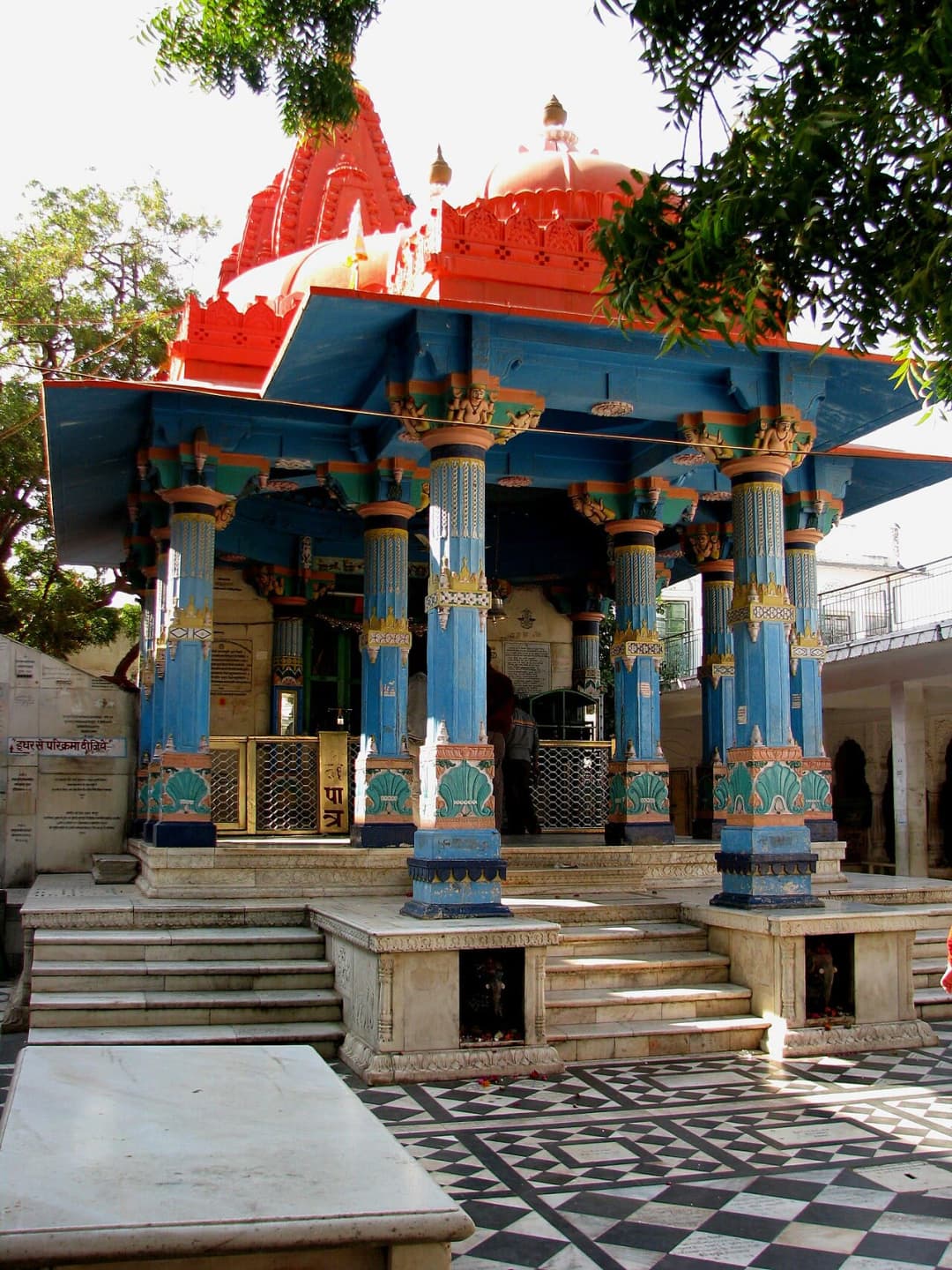
The structure standing today is dated to the 14th century, with later partial rebuilding. It is marble and stone slabs. The spire is red and runs to about seventy feet, and a hamsa, the goose, is worked into the main entry gate.
Inside the garbhagriha is the chaumurti, the four-faced image: life size, four hands, four faces, one to each cardinal direction. The floor is marble in black and white checks, and devotees have inlaid it — and the walls — with hundreds of silver coins. A silver turtle sits on the floor facing the sanctum.
Gayatri has a shrine inside the temple, alongside Brahma's image. Savitri has one too, on the Ratnagiri hill behind. Both women from the curse story are housed: one in the building, one above it. Tact or bookkeeping, it is consistent.
The older layer underneath the dates
Tradition pushes the site back well before the 14th century. The temple is said to have been renovated by Adi Shankara, and the marble image recorded as installed in the sanctum in 718 CE at his hand. I will pass that date along without leaning on it: the figure travels better than its evidence, and a site this old is normally several buildings wearing one name.
Nineteenth-century repairs and decorative additions are also on record, and whoever carried them out is credited with keeping the original design — which is not what usually happens.
Who built, who pulled down, who paid
The lake's edge is a ledger of patrons. Raja Man Singh I of Amber built the Raj Ghat and the Man temple. The Marathas added to the town in their turn. As late as 1956 the Maharaja of Jaipur gifted the Jaipur Ghat and the Main Palace.
Against that, the losses. Jahangir put up a hunting lodge on these shores in 1615–16, and the Varaha temple — generally credited to a twelfth-century Chauhan ruler, so older than any of the rest of this — was damaged in his reign and afterwards rebuilt by Maharaja Bakht Singh of Marwar. Many of Pushkar's temples, this one included, were destroyed or desecrated during Aurangzeb's rule between 1658 and 1707, and were rebuilt afterwards. Very little at this lake is first-generation.
Who exactly paid for what is harder to pin down than it looks. The builder-and-donor lists that circulate for these ghats contradict one another, and the same name turns up attached to different dynasties in different accounts. The shape of the thing is not in doubt, though, because it is written on the steps: several ghats are named for the states that funded them — Gwalior, Kota, Jaipur — alongside Varaha, Dadhich, Saptarishi, Gau, Yag, Karni and Gangaur. A ghat here was a subscription.
The names keep the receipts
That habit of naming did not stop with the kings. The Gau Ghat was renamed Gandhi Ghat after Mahatma Gandhi's ashes were immersed there. A place at this lake tends to be named for what happened at it — which is what the Purana says about the town's own name: a flower, a hand, an event.
Who is allowed to stand where
One rule at the Brahma temple is worth stating plainly: householders — married men — are not permitted into the sanctum sanctorum to worship the image. Only ascetics, sanyasis, go in.
The bath, and this year's date
The day is Kartik Purnima, the full moon of Kartik. On this year's panchang it falls on Tuesday 24 November 2026, and the row for that date prints Pushkara Snana among the day's observances. The bright-half eleventh of the same month, printed as Devutthana Ekadashi, falls on Friday 20 November 2026, and the fair's traditional span is described as running from that ekadashi through to the full moon; the fair itself is generally given as seven days. It is the same full moon that lights the lamps at Dev Deepawali in Varanasi, several hundred kilometres east.
What is claimed for the dip is large: a bath here on that day is put as equal in benefit to fire-sacrifices performed over several centuries. What the fair draws in practice is around two hundred thousand people and upwards of fifty thousand camels. The livestock side is not incidental — under the British Raj the pilgrimage and a cattle fair were deliberately run together.
The year the lake was not there
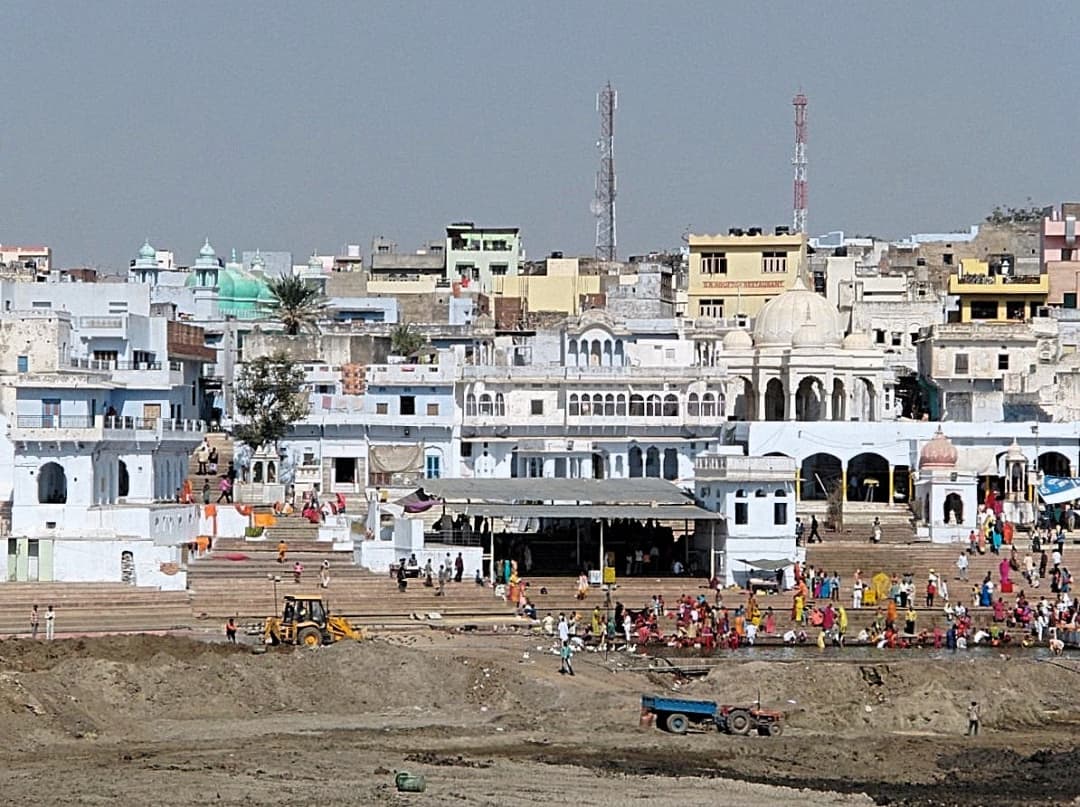
In 2009 the lake dried up completely during the fair. The arrangement made was concrete tanks near one of the upper ghats, filled from tube wells drawing groundwater. People came and bathed in those. The lakebed has been dredged and desilted since — the photograph above is that work: earthmoving plant standing on ground meant to be under water, and a line of bathers in what is left of it.
The tithi did not move. That is the part worth sitting with. The date is astronomical and the water is infrastructure, and in a dry year the town supplied the second one with pumps rather than renegotiate the first.
The part I am not going to settle
Two scriptures explain one absence two different ways, and I see no honest method for choosing between a curse about vanity and one about a marriage. Both are recorded, both are believed in different rooms, and the absence they explain is real either way.
The other claim needs a correction rather than a judgement. Pushkar is routinely called the only Brahma temple in the world. It is not, and the same reference that records the claim notes it no longer holds; the plainer phrasing used elsewhere is that this is one of the few temples dedicated to Brahma. It need not be the only one. It is the one with a date on it, a fair around it, fifty-two ghats of subscriptions, and a crowd that turns up on the full moon whether or not the lake is full.
The name says a flower fell out of a hand. Centuries of dam-building, demolition, patronage and dredging later, the town is still arranging itself around the spot where it landed. If you are keeping Kartik at home this year rather than travelling, the full moon over your own courtyard is the same full moon.


