Dhanurmasa and Margazhi: A Month Before First Light

Your call came in at twenty past five and you apologised for it twice, which was the only unnecessary part of the conversation. Everyone was already awake. That is the thing I want to explain, because you asked two questions in the same breath without realising they were one: why was the house up at five, and why has your mother gone quiet about the wedding date you picked for the 27th of December.
The answer to both is a month.
The month begins mid-morning, not at dawn
The month is Dhanurmasa. In Tamil it is Margazhi, the ninth month of the Tamil calendar, and it begins when the Sun crosses into Dhanu — Sagittarius. In this cycle that crossing falls on Wednesday 16 December 2026, and the panchang for Chennai puts it at 10:29 in the morning.
Not at sunrise. Not at midnight. Mid-morning, while people are at work. Hold on to that, because it is the clue to what kind of observance this is.
Almost everything else the family marks is a tithi — a lunar day, which wanders about the Gregorian calendar and has to be looked up every year. This one is solar. The Sun enters a sign and stays there for roughly a month, and the month ends when it moves on into Makara: Friday 15 January 2027, which you know by its other name, Pongal.
| What | Date this cycle |
|---|---|
| Dhanu Sankranti — the month opens | Wed 16 Dec 2026, Sun into Dhanu 10:29 AM (Chennai) |
| Vaikuntha Ekadashi | Sun 20 Dec 2026 |
| Arudra Darshan, on the Margashirsha full moon | Thu 24 Dec 2026 |
| Makara Sankranti and Pongal — the month closes | Fri 15 Jan 2027 |
Two different months are called almost the same thing
This is where I would stop trusting any single source, including this letter.
The name comes from a star. Margazhi is named for the Moon standing near Mrigashirsha — Mirugashirisham — on the full moon night. The Sanskrit lunar month Margashirsha takes its name from the same star in the same way.
They are not the same month. One is reckoned by the Sun and the other by the Moon. On 16 December, the morning the solar Margazhi opens, the panchang also prints the lunar date, and that lunar month is Margashirsha, already twenty-two days along. It closes on its own full moon on 24 December — eight days after the solar month it nearly shares a name with has begun. One star, two reckonings, about nine days of overlap.
And the star has slipped out from under the name. The full moon of 24 December 2026 does not stand in Mrigashirsha at all. It stands in Ardra, the next star along — which is precisely why the Shaiva festival of Arudra Darshan falls that morning and not another. The name records an alignment, and the alignment is approximate. So if anyone tells you the name settles a question about the reckoning, they are compressing two calendars into one word.
Why your mother has gone quiet about the 27th
Dhanurmasa carries a second name. Shoonya Masa — the blank month.
The convention is that nothing is begun inside it except worship. No wedding, no griha pravesham, no opening of a shop, no laying of a first stone. The reason given in the published accounts is a matter of attention: the month is set aside for worship, and the ordinary auspicious business of life waits until the Sun reaches Makara — which is to say until 15 January.
Be careful what that is and is not. It is a scheduling convention with a reason attached, not a verdict on a marriage or on the two people in it, and plenty have married inside the blank month and been perfectly happy. But the priest your family will actually telephone, and the hall, and every aunt with a view, are all working from the same convention, and 27 December sits squarely in the middle of it. The first clear water is after Pongal.
What actually changes, which is less than you expect
Nothing new is offered in this month. No deity arrives who was not there in November, no rite is invented for it. The worship is simply moved earlier — into the hour and a half or so before sunrise that the texts call Brahma muhurta — and repeated, every single day, for a month.
In a temple that means the sanctum opens early and the first worship of the day is done in the dark. The bronze that travels, the utsavar as against the fixed moolavar in the sanctum, goes out through streets that have not woken up.
A long temple corridor is built for exactly this hour and you only notice it then. At noon the mandapas simply read as large. Before light they become a sequence of dark rooms with one bright doorway at the far end of each, the granite cold through the soles of your feet, the carved pillars legible only where a lamp happens to be standing. The building was designed by people who expected to walk through it in the dark.
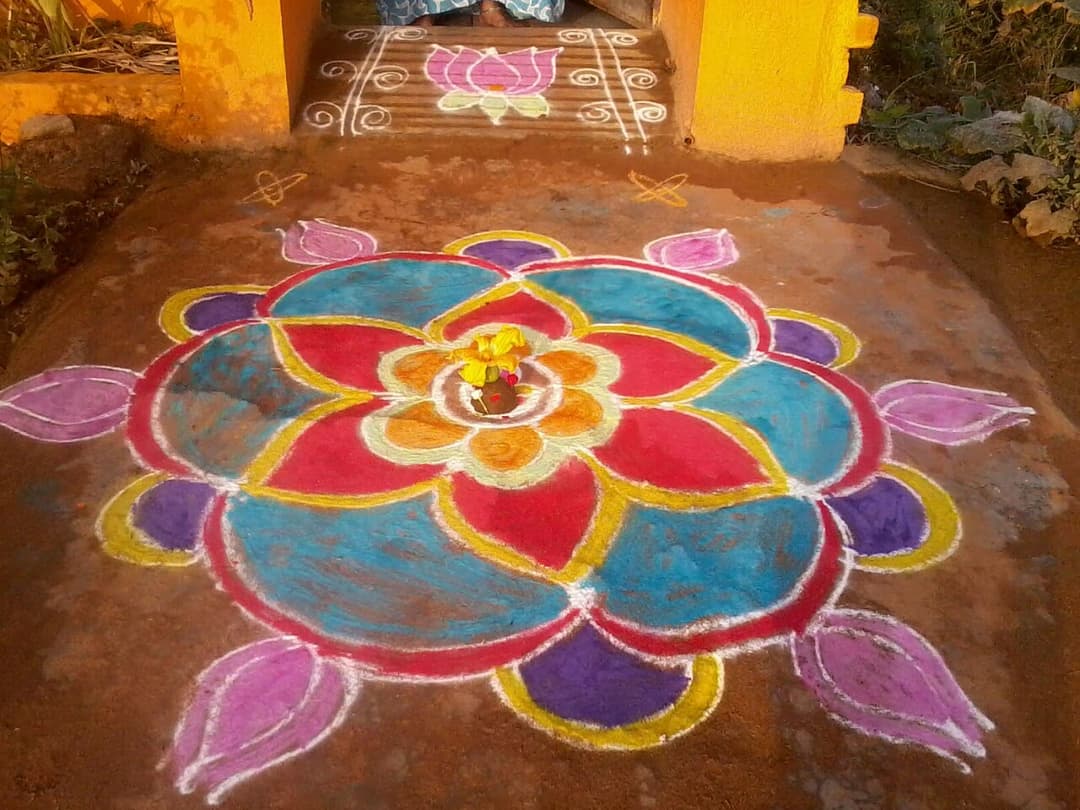
At home it is smaller and harder. The kolam goes down before light. The lamp is lit before light. Somebody has had to be awake before any of it to boil the water.
There is a text for every single morning
For the Vaishnava side there is the Thiruppavai — thirty verses, pasurams, by the poet-saint Andal, part of the Nalayira Divya Prabandham, the collected work of the twelve Alvars. Thirty verses, one for each day of the month.
For the Shaiva side there are twenty: the Thiruvempavai of Manikkavachakar, from the Thiruvasagam, the eighth book of the Tirumurai. Those twenty are sung one a day, then followed by the ten songs of the Thiruppalliyezhuchi, the hymn for waking the god. Twenty, and then ten.
So two traditions, arriving by quite different routes, each end up with exactly thirty mornings' worth of text for a thirty-morning month. I have no tidy explanation for that and will not invent one. It is a thing you notice once both lists are in front of you.
The Shaiva set travelled a long way: a ceremony in the Thai royal calendar, Triyampawai, one of the twelve royal Hindu ceremonies there, is described as descending from the Tiruvempavai.
The vow in the poem is harsher than the month most houses keep
Andal writes in the voice of a cowherd girl, and the vow her verses describe is not a gentle one: bathe daily before dawn, no ghee, no milk, no kohl on the eyes, no flowers tied in the hair, for the length of the month.
That is the vow in the poem. It is not what most households keep. What most households keep is the hour. Better you hear that now than arrive in January believing your aunts have spent thirty days off milk.
The two mornings that are not about the hour
Two dates inside the month are observances in their own right rather than a change of schedule, and both will be crowded. Vaikuntha Ekadashi falls on 20 December, and what happens at Srirangam on it — a door on the northern side that opens one morning a year — has been written about here already. Arudra Darshan falls on 24 December, on that drifted full moon, and belongs to Shiva as the dancer.
The part I cannot settle for you
I am not a priest, I have never recited the Thiruppavai from memory, and until this month I did not know that the Shaiva twenty sat alongside the Vaishnava thirty at all.
So: I cannot tell you that worship at twenty to five reaches any further than worship at seven. Nobody has given me a straight answer about that, and the people most convinced of it are not the ones who had to light the stove. Nor can I tell you where Shoonya Masa comes from. Every account I read states the convention and none grounded it in a text I could check — which is not the same as the convention being baseless, but it is not a citation either.
What to tell your mother
Tell her you have understood why she went quiet, which is the part she is waiting for. Then ask her for a date after Pongal and let her win.
And if you are up at five anyway, whatever your own clock is doing to you there, a lamp is not a difficult thing to light. That is the whole of the month with the calendar stripped off it. Same prayer, earlier, for thirty days, in the dark.