
Govardhan Parikrama: the 21 km Circuit Around Giriraj

The Govardhan parikrama is a 21-kilometre walk around a low rocky hill in Mathura district, and almost nobody who does it sets foot on the hill itself. The route is flat, it is walked clockwise, and traditionally barefoot. An unhurried circuit takes about five hours, costs nothing, and is open at every hour of every day.
Key takeaways
- The circuit is roughly 21 km, starting and finishing at Daan Ghati or Mansi Ganga in Govardhan town, about 21 km from Vrindavan.
- The hill is low — around 30 metres above the fields, but some 8 km long, which is where the distance comes from.
- You go around Govardhan, never over it. The hill is treated as Krishna, not as a place associated with him.
- Busiest in Kartik (27 October to 24 November in 2026) and on Govardhan Puja, Tuesday 10 November 2026.
Why is the Govardhan parikrama 21 kilometres?
Because of a unit nobody uses any more.
The circuit is traditionally reckoned as sapta kos — seven kos. A kos was an old road measure, somewhere around three kilometres, but it was never standardised and it varied from one region to the next. Seven times roughly three gives roughly twenty-one. That is the whole arithmetic.
It also explains the spread. Published distances for this walk run from 21 to 25 kilometres and none of them is a misprint — they are honest conversions of a figure that was never metric to begin with. If you want one number to plan around, 21 km and five hours is the one locals use.
The hill itself is modest. It runs about eight kilometres end to end and stands roughly thirty metres above the surrounding land — lower than a ten-storey building. Part of the parikrama path crosses out of Uttar Pradesh altogether and into Deeg district in Rajasthan, which surprises people who assume the whole thing sits inside Braj's administrative boundary.
What are the stops on the Govardhan parikrama?
Taken clockwise from Daan Ghati, these are the ones worth slowing down for. The order shifts depending on where you join.
| Stop | What is there | Worth stopping? |
|---|---|---|
| Daan Ghati Mandir | The usual starting point; the busiest stretch of the route | Yes — but it is a crush on festival days |
| Mansi Ganga | A large tank in the middle of Govardhan town, ringed with ghats | Yes, especially at dusk |
| Jatipura (Mukharvind) | The "lotus face" of the hill; milk is poured over it daily | Yes — this is the devotional centre of the circuit |
| Punchhari ka Lautha | The tail end of the hill, and a small temple to Lautha Baba | Yes, and it is the quietest stretch |
| Govind Kund | A tank on the southern arc | Brief stop |
| Radha Kund and Shyam Kund | Twin tanks with stone ghats, a village in its own right | Yes — allow proper time |
| Kusum Sarovar | Sandstone tank and chhatris between Mansi Ganga and Radha Kund | Yes, the best-built thing on the route |
Daan Ghati is named for the daan, the toll. The story told there is that Krishna stopped the gopis on this pass as they carried milk and curd to market and demanded a tax in kind. It is where most parikramas begin, which also makes it the least peaceful part of the walk.
Jatipura is where the hill has a face. The Mukharvind is the rock treated as Govardhan's mouth, and it is bathed in milk every day by a steady queue of people. On the morning of Govardhan Puja this is where the annakut goes — the mound of cooked food offered to the hill.
Punchhari ka Lautha sits at the punchh, the tail. The temple there is to Lautha Baba, remembered as one of Krishna's companions. It is the far point of the loop, four or five kilometres from anything, and on an ordinary weekday you can hear birds.
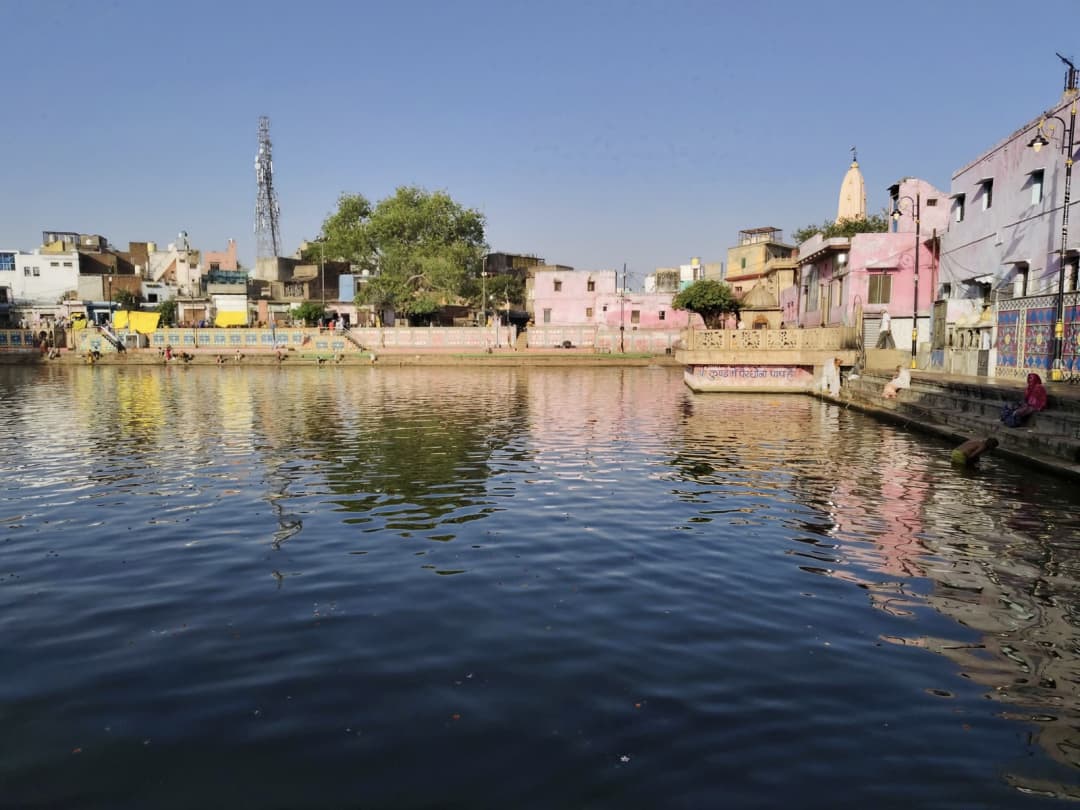
Radha Kund and Shyam Kund are two tanks side by side, with houses and small temples pressing right up to the water. Radha Kund has a night of its own in the calendar — the midnight bath on Ahoi Ashtami, which in 2026 falls on Sunday 1 November.
Kusum Sarovar is the one piece of real architecture on the circuit, and it is not a temple. The sandstone terrace and the domed chhatris above the water were built by Jawahar Singh as a memorial to his father, Suraj Mal of Bharatpur, with two smaller pavilions for the queens Kishori and Hansiya. A Jat ruler's cenotaph, in the middle of a Krishna pilgrimage, with Radha-Krishna scenes painted on the ceilings.

Why does nobody climb Govardhan hill?
This is the rule that makes the walk what it is, and it is worth understanding before you go.
At most pilgrimage sites you climb towards the god. Here you do not, because the hill is not where Krishna is. The hill is Krishna. Walking on it is understood as walking on the deity. Vallabhacharya is recorded as having gone around the hill in 1515 without once stepping onto it, for exactly this reason, and five centuries later it still holds — people will walk twenty-one kilometres around a thirty-metre rise rather than take the two-minute shortcut over the top.
The same logic runs the other way too. A stone picked up from Govardhan is a Govardhana shila, and in the Vallabha tradition it is not a souvenir or a relic. It is worshipped exactly as a temple image of Krishna is worshipped, with the same daily service. Which is why you do not casually pocket one.
There is also a story about why the hill is so low. Pulastya, the story goes, asked for the hill and was tricked into setting it down, and in his anger cursed it to shrink by the width of a mustard seed every day. Whether you take that as cosmology or as an old explanation for erosion, it does describe something real: people have been saying for a long time that Govardhan is getting smaller.
When is the best time to walk it?
| Occasion | 2026 date | What changes |
|---|---|---|
| Month of Kartik | 27 Oct – 24 Nov | The traditional season; crowds all month |
| Govardhan Puja | Tue 10 Nov | Annakut at Jatipura; the heaviest single day in Kartik |
| Radha Kund Snan | Sun 1 Nov | Midnight bathing at Radha Kund |
| Mudiya Purnima | Guru Purnima, in Ashadha | A seven-day fair; crowds counted in crores |
Kartik is the month for this walk, and Govardhan Puja is its peak. That is also the morning of the annakut, which in 2026 falls on Tuesday 10 November rather than the day after Diwali, for reasons that come down to which tithi is running at sunrise.
The largest crowds, though, are not in Kartik at all. They come in the monsoon, at Mudiya Purnima — a seven-day fair in the month of Ashadha, ending on Guru Purnima, that marks the passing of Sanatan Goswami, one of the six Goswamis of Vrindavan. Pilgrims shave their heads, which is where the name comes from. Reported attendance for the week runs into crores; treat that as an administrative estimate rather than a count, but the scale is not in doubt.
For an ordinary walk, October to March is the sensible window. May and June are punishing on an unshaded road, and barefoot on hot tar is not devotion, it is an injury.
Is there more than one way round?
Yes, and the variations are where the real intensity shows.
- On foot, barefoot. The standard. Four to five hours.
- Dandauti parikrama. Prostrating full length, marking the spot your hands reached, standing, stepping to the mark, and going down again — for the whole circuit. One account puts it at roughly 17,300 prostrations and seven to eight days.
- Dugdh parikrama. Pouring a thin stream of milk along the route as you go. Forty to forty-five litres for a full round.
- By road. Rickshaws work the parikrama marg, and most older pilgrims use them.
What I cannot settle
Whether the hill is shrinking in any measurable way. The mustard-seed story is old and specific; the modern claim that Govardhan once stood enormously higher is not something I can check, and I would not repeat it as fact.
What I can say is what the hill looks like now. It is a ridge of pale broken sandstone, scrub and thorn trees, more modest than any first-time visitor expects. It does not look like something twenty-one kilometres of walking is owed to. People give it anyway.
Questions people ask
How long is the Govardhan parikrama?
About 21 kilometres, walked clockwise around the hill, and most people finish in four to five hours without hurrying. Published figures range from 21 to 25 km because the traditional measure is seven kos, and a kos was never a fixed length.
Where does the Govardhan parikrama start?
Most people start at Daan Ghati in Govardhan town, or a few minutes away at Mansi Ganga. The route is a loop, so it ends where it begins and either entry point works.
Why do people not climb Govardhan hill?
Because the hill is understood to be Krishna himself rather than a place where Krishna did something. Walking on it is treated as walking on the deity. Vallabhacharya is recorded as having kept this rule on his circuit of the hill in 1515, and it has held since.
Can you do the Govardhan parikrama without walking?
Yes. The parikrama marg is a road and rickshaws work it, which is how many elderly pilgrims and families with small children get round. Walking barefoot is the traditional form and still the one most people aim for.
When is the best time to do the Govardhan parikrama?
The month of Kartik, which in 2026 runs 27 October to 24 November, and especially Govardhan Puja on Tuesday 10 November 2026. October to March is comfortable walking weather generally; May and June are punishing.


