
Halmaddi: The Vanishing Resin Behind Old Indian Incense
If you grew up in a South Indian house, you may carry a memory you have never quite placed. The incense of a certain era — the coils and sticks of the 1980s and 90s, the ones an aunt lit in front of the photographs — had a particular character. Not sharp. Not floral in the loud way. Something softer and rounder, faintly sweet, almost like the smell of the earth just after the first rain. You notice it most by its absence: light a modern budget agarbatti and it is brighter, thinner, gone the moment the smoke clears.
A good deal of that lost softness came from a single ingredient, and it is one almost no one who burns incense has ever heard named. It is a forest resin called halmaddi, and the story of why it has grown scarce is really the story of how hand-made incense changes when a material becomes too dear to use.
What halmaddi actually is
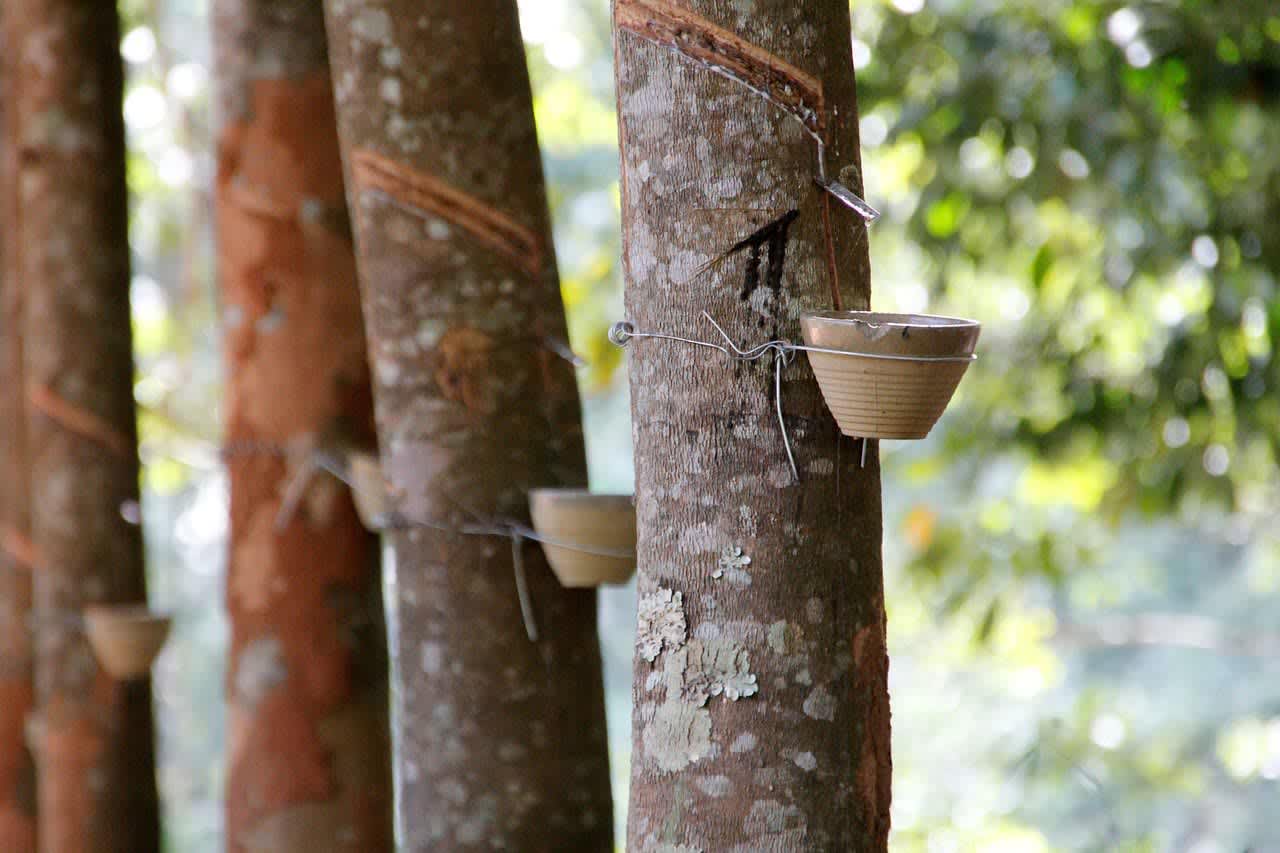
Halmaddi is a resin — a grey, semi-liquid gum tapped from a tree. The tree is Ailanthus triphysa, which grows through the moist forests of peninsular India and along the Western Ghats, the same hill spine that catches the monsoon before it reaches the plains. Tap the bark and the tree weeps a thick, sticky exudate the colour of wet ash. Left to itself it slowly hardens; kept warm and worked, it stays pliable and faintly aromatic.
Unlike a dry powder such as sandalwood or a milled bark gum, halmaddi arrives at the workshop as something between a paste and a syrup. That physical quality — soft, tacky, slow to set — is the whole point of it. It is what the resin does with its hands, so to speak, that mattered to the people making incense.
What it does in the making
There are two jobs a material can do in a stick of incense, and halmaddi did both.
The first is binding. A rolled agarbatti is a paste of charcoal and fine wood powder pressed onto a bamboo sliver; something has to hold that paste together and glue it to the stick. Most makers do this with jigat, a gum milled from tree bark. Halmaddi can do the same work, and in a wet dhoop — the cone or the hand-shaped kind with no bamboo core at all — its stickiness is what lets the mixture be moulded and keep its shape without cracking.
The second job is the quieter one, and it is why perfumers prized it: halmaddi is a fixative. A fixative is a material that slows down the more delicate, volatile scents so they release evenly instead of flashing off in the first minute. Flowers are the classic problem here. A floral note — champa, a soft jasmine, a rose — is fragile; on its own it burns away almost as fast as it appears. Blend it into a base carrying halmaddi and the resin holds the fragrance back, letting it unfold slowly over the whole burn. The famous nag champa style of incense, that soft powdery sweetness so many people associate with Indian agarbatti, leans heavily on exactly this. The resin is not the star. It is the thing that lets the star stay on stage.
There is a workshop detail worth adding, because it is the kind of thing you only learn with the paste in your hands. A dough carrying halmaddi behaves differently under the heel of the palm — it stays workable longer, forgives a little, and dries down softer rather than snapping hard as a matchstick. Old hands could feel the resin in a mix before they were told it was there.
Why it is disappearing
Here is where the craft story turns, and it turns on something outside the workshop entirely.
Halmaddi is a forest product, not a farmed one. For a long time it was tapped the way such things often are — quickly, crudely, by whoever could reach the tree. Deep cuts were slashed into the bark to make the resin flow faster, and trees tapped that hard do not recover. Whole stands began to die. By the 1990s the damage was serious enough that the Forest Department restricted extraction, and the supply of halmaddi collapsed almost overnight.
What follows is simple economics with a sad edge. A material that was once cheap and common became rare and expensive. Makers who had built their signature blends around it could no longer afford to use it as they had. Some replaced it with synthetic substitutes that mimic the stickiness but not the scent. Many simply left it out and reformulated around cheaper binders. The soft, honeyed character quietly went out of a great deal of everyday incense, and most people never knew a specific ingredient had left the room — they only felt that the old sticks had smelled somehow fuller.
Extraction was later permitted again under controlled leasing, and small, careful supplies exist. But halmaddi remains scarce enough that it is sometimes tapped illegally and sold on the side, which tells you plainly how much of it there is to go around: not much.
What most workshops do now
It would be easy to end this on a note of loss, but the honest picture is more practical. Most hand-rollers today, ourselves included, build the everyday stick on jigat, the bark gum, rather than halmaddi. It binds reliably, it is available, and it does not depend on wounding a slow-growing forest tree. In our own small workshop in Samastipur the paste is charcoal, wood powder and jigat, worked with water and rolled by hand — no resin syrup in the mix. That is not a compromise we hide; it is simply what a scarce material forces on anyone who wants to keep making incense at a fair price.
Where halmaddi still belongs is in the smaller, deliberately traditional blends — the ones that exist precisely to carry a soft floral the old way, and whose makers accept the cost because the whole point is that particular scent. If you are ever drawn to the powdery, honeyed character of a classic Indian floral, that is very likely the resin you are smelling, doing its patient work of holding the flower in place.
A material with a shelf life
There is something fitting about all this. Incense is the one household object built entirely to disappear — you buy it in order to burn it, and its whole life is measured in the minutes of a single stick. It seems right, in a way, that one of its most beloved ingredients should itself be something that cannot last, that comes from a wounded tree in a shrinking forest, that grows scarcer each year.
The next time an old incense smells fuller than a new one — softer, rounder, sweeter in a way you cannot name — you will at least know what to reach for in your memory. Somewhere behind it is a grey resin from a Western Ghats tree, doing quietly what it has always done, for as long as there is any of it left to do it with.


