
Jagaddhatri Puja: Why It Is Not a Second Durga Puja

Jagaddhatri Puja is not a smaller Durga Puja held a month later. It is the worship of a distinct form of the goddess, on a different tithi, with a ritual structure that can fold three days of worship into a single day. In 2026 it falls on Wednesday 18 November.
Key takeaways
- Jagaddhatri Puja 2026 is on Wednesday 18 November, the Navami of the bright fortnight of Kartika.
- She is not a scaled-down Durga. Four arms, not ten; a lion standing on an elephant, not on a buffalo demon; a name that means the one who holds the world up.
- The core rite is a single day. Saptami, Ashtami and Navami worship are performed on the Navami tithi itself, one after another.
- The festival is documented, not immemorial — it traces to eighteenth-century Nadia, and to community pujas in Chandannagar from around 1790.
When is Jagaddhatri Puja in 2026?
Wednesday 18 November. That is the day the panchang lists Jagaddhatri Puja, and it is Kartika Shukla Navami at sunrise.
It is worth looking at the surrounding days, because this year the tithi does something that trips people up. Navami does not end before the next sunrise — it runs through the whole night and is still going on the morning of Thursday the 19th. A tithi that touches two sunrises like this is called a vriddhi. The festival does not move with it.
| Date | Tithi at sunrise | What the day-panchang lists |
|---|---|---|
| Tue 17 Nov 2026 | Ashtami, until 06:04 am on the 18th | Gopashtami, Masik Durgashtami |
| Wed 18 Nov 2026 | Shukla Navami, running all night | Jagaddhatri Puja, Akshaya Navami |
| Thu 19 Nov 2026 | Navami again, until 07:05 am | no festival listed |
Those timings are calculated for New Delhi and shift by a few minutes further east, so a Kolkata or Chandannagar almanac will not read identically to the minute. The date does not change.
This is also why it is a bad idea to work out a festival by counting days forward from another one. The tithi is the unit, not the calendar square, and in a year like this one the two come apart.
Who is Jagaddhatri, and how is she different from Durga?
Start with the name. Jagat is the world; dhatri is the one who bears or holds it. She is the holder of the world — not, in the first instance, the killer of anything.
Then look at her. She has four arms, carrying a bow, an arrow, a chakra and a conch. She is red, like the sun coming up, and wears a garland of snakes. She sits on a lion. Under the lion's feet is an elephant.
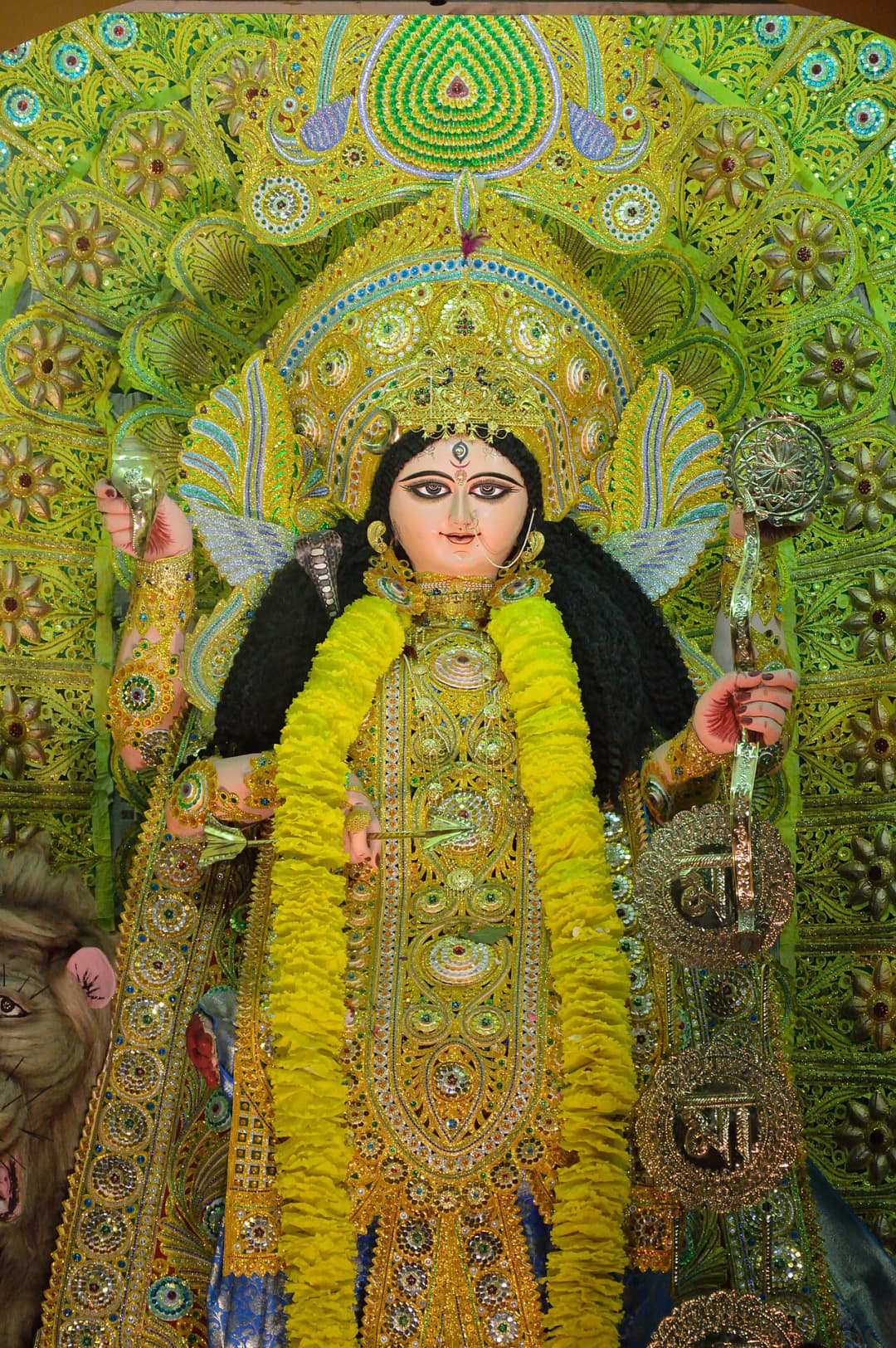
The elephant is the part worth slowing down for. He is Karindrasura, a demon in elephant form, and the common reading of him is ahamkara — ego, the I-making faculty. So the composition is not a battlefield. It is a hierarchy: ego at the bottom, the lion's strength standing on it, the goddess seated above both, unhurried.
Set that beside the Durga image, where the goddess has ten arms and a spear going into Mahishasura, and the difference stops being decorative. Ramakrishna's line about her is often quoted and it is the clearest gloss anyone has given: "She is carrying the world. If she stops then the world will get destroyed." Durga, in her Puja, has just won something. Jagaddhatri is holding something, continuously, and has not put it down.
Why are three days of worship done on one day?
Because the rite is built that way. In the stricter observance, the Saptami, Ashtami and Navami pujas are all performed on the Navami tithi, in three successive portions of the day — purvahna in the forenoon, madhyahna around midday, aparahna in the afternoon — each with its own offering, and the pushpanjali repeated for each. Belur Math keeps it this way. The day ends with homa and the evening arati.
Nothing in Durga Puja does this. There, the four days each have their own character and cannot be collapsed into each other — Saptami brings the goddess in, Ashtami carries the sandhi moment, Dashami sends her away. The days are a sequence with a shape.
Jagaddhatri Puja can be celebrated across several days or on the Navami alone, and that flexibility is the tell. A festival whose entire liturgy fits inside one sunrise-to-sunset is not an abbreviation of a four-day one. It was never four days to begin with. Where towns do keep it longer, the extra days are the public festival growing around the rite, not the rite itself stretching.
Where did Jagaddhatri Puja come from?
Unusually for something this established, there is an answer with a century attached to it.
The worship is credited to Maharaja Krishnachandra of Krishnanagar, in Nadia, in the eighteenth century. The story told about it is that he was imprisoned by Nawab Alivardi Khan and so missed Durga Puja, and that on his release he had a vision of Jagaddhatri and began her worship. You can treat the vision as devotional narrative and still keep the useful part: a named ruler, a known town, a datable period. Community barowari worship at Chandannagar is recorded from around 1790, and some pujas there and at Kalna count their age in centuries. The Jagaddhatri Puja record keeps these threads together.
That matters for the question this article is asking. A festival that began in the 1700s in a specific royal house is not a leftover or an overflow of an older one. It is its own institution, and it has had about three hundred years to become one.
What makes Chandannagar's Jagaddhatri Puja different?
Chandannagar was French. The settlement dates from 1696, and it stayed French through the whole British period — a referendum in June 1949 went overwhelmingly for joining India, sovereignty was ceded in 1951, and the town was merged into West Bengal in 1954. Walk the Strand along the Hooghly and the promenade still says so.
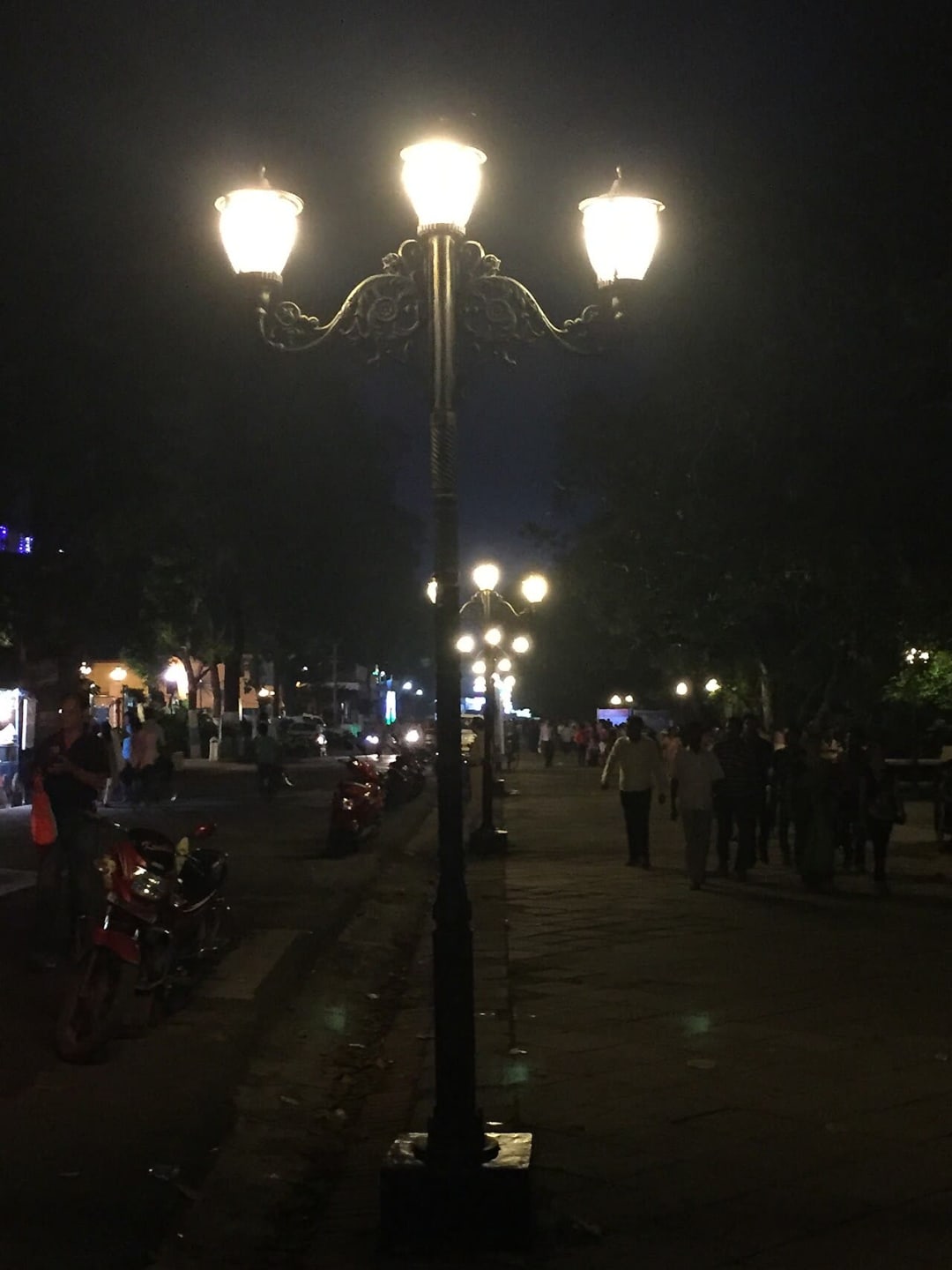
In that town, Jagaddhatri Puja is not the second festival. It is the festival — bigger locally than Durga Puja, with idols often standing over twenty feet, built by the same kind of workshop tradition that shapes a Durga image from straw, clay and river silt. The immersion procession moves these down to the Strand on hand-pushed carts, and people stand out all night to watch it.
And there is the lighting. Chandannagar's illuminated panels — animated tableaux built from thousands of small bulbs, an art the town has been refining since the 1960s — are what light up pujas across Bengal and well beyond it. Which produces the detail that says everything: the town that makes the lights for everyone else's Durga Puja waits until Durga Puja is over, and then holds its own.
So is it a second Durga Puja?
Here is what I actually think.
The case for saying yes is not stupid. Both are Bengali, both are Shakta, both put a goddess in a pandal for the neighbourhood, both end in a river. In Chandannagar and Krishnanagar the public shape of the thing — the crowds, the pandal-hopping, the all-night immersion — looks very like Durga Puja, deliberately so. If you only ever see the street, you will reach for the comparison, and the comparison will get you most of the way to behaving properly as a guest.
But the parts that make it a festival rather than a street scene all point the other way. A different goddess with a different number of arms and a different defeated creature. A different argument — bearing the world rather than winning a battle. A liturgy that fits in one day, by design. A traceable eighteenth-century origin. And a town where it is the main event rather than the sequel.
So: no. It is not a second Durga Puja, and the "second" is the word doing the damage — it sorts the whole thing as derivative before anyone has looked at it. The common belief turns out to be right about one real thing, which is that the two festivals have borrowed each other's public form, and wrong about everything underneath it.
If you are near Chandannagar on the 18th, go at night. And look at the base of the idol before you look at the lights.
Questions people ask
When is Jagaddhatri Puja in 2026?
Wednesday 18 November 2026, which is Kartika Shukla Navami. Because the Navami tithi stretches past the following sunrise this year, it is still running on the morning of 19 November, but the puja is kept on the 18th.
Is Jagaddhatri the same as Durga?
She is understood as a form of the same goddess, but she is not depicted or worshipped the same way. Jagaddhatri has four arms rather than ten, rides a lion standing over an elephant rather than a buffalo demon, and her name means the bearer or holder of the world.
Why is Jagaddhatri Puja done in one day?
In the stricter observance the Saptami, Ashtami and Navami worship are all performed on the Navami tithi itself, in three successive portions of the day. Some places keep a longer public festival around it, but the core rite is built to be completed in a day.
What does the elephant under the lion mean?
The elephant is Karindrasura, a demon in elephant form, and he is widely read as ahamkara, the ego. The lion the goddess rides stands on him.
Why is Jagaddhatri Puja so big in Chandannagar?
Chandannagar, a French settlement until the early 1950s, has kept community Jagaddhatri Puja since around 1790. It is the town's largest festival, known for very tall idols, illuminated tableaux and an immersion procession along the Strand.


