
Kōdō vs Japanese Incense Sticks: Listening to Fragrance

In a storehouse at Nara there is a log of agarwood about a metre and a half long and weighing a little under twelve kilograms. It has a name, Ranjatai, and almost everything recorded about it is a list of occasions on which somebody was permitted to cut a sliver off it. A study of the wood in 1997 counted around fifty such trimmings across its history.
Three of the cuts have famous names on them. In 1465 the shogun Ashikaga Yoshimasa took two pieces of about two and a half centimetres square. In 1574 Oda Nobunaga took one about five centimetres long. The Meiji emperor trimmed off 8.9 grams, had it split in two, kept one half and burned the other.
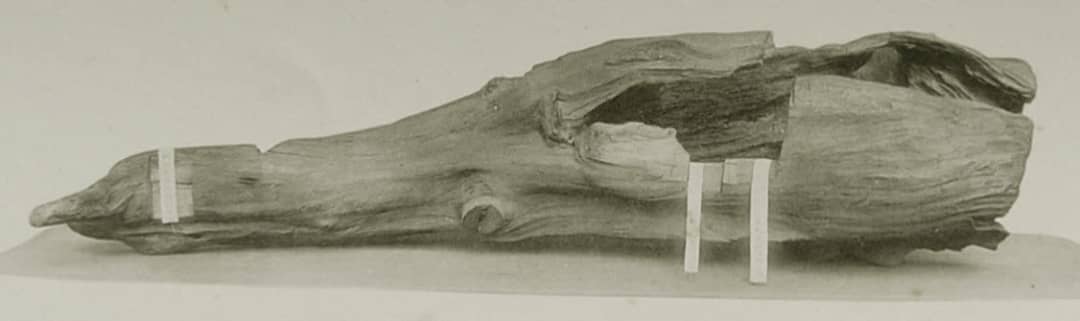
That is a strange thing to do with a piece of wood, and it is the shortest way I know to explain what Japan did with incense that nobody else did. Nothing in the story involves a stick.
The confusion starts on a shop shelf
What a buyer in London or Los Angeles meets under the label Japanese incense is a thin, pale, coreless stick, usually made on Awaji Island, where most of Japan's incense now comes from — an industry that arrived there from Sakai, near Osaka, only in the nineteenth century. Those sticks are excellent. They are also not kōdō, and no amount of buying them will get you closer to it.
Kōdō — the Way of Incense — is counted as one of the three classical arts of refinement, alongside kadō, the way of flowers, and chadō, the way of tea. It uses chips of fragrant wood, not sticks, and it does not set them alight. A fragment is placed on a small mica plate called a gin-yō, which sits over a piece of charcoal buried in ash inside a censer shaped rather like a cup. The wood is heated until the resin in it volatilises and no further. The mechanics of supplying heat to a material instead of letting it burn itself will be familiar to anyone who has used a charcoal burner for bakhoor; the difference is what Japan built on top of it.
"Listening" is not a translator's flourish
The word for what you do at the censer is monkō, and it is usually rendered as "listening to incense". It would be easy to treat that as poetry. It is not. The verb was chosen, and the etiquette around it is built as if hearing were really the sense involved.
The censer is taken in the right hand and set on the open left palm, held level. The right hand cups over the rim so the fragrance gathers instead of dispersing, and you put your face to the gap between thumb and forefinger. Convention gives you three breaths — practitioners describe them as right, left, centre — and then the censer goes on to the next person and does not come back. Three breaths is roughly ten seconds. You are not given the chance to check.
Once you know that, the choice of verb stops looking decorative. Smelling is passive and continuous; you cannot help it. Listening is attentive, effortful and bounded, and it is the kind of thing you can be bad at.
A vocabulary for the things that have no words
Being bad at it implies a standard, and Japan built one. The classification is called Rikkoku Gomi — "six countries, five tastes". The six are Kyara, Rakoku, Manaka, Manaban, Sumotara and Sasora, names that gesture at the regions the wood was thought to come from. The five are borrowed wholesale from the tongue: sweet, sour, hot, salty, bitter.
Which taste belongs to which name is a thing I would treat carefully. The sources that print a tidy table do not agree with each other, which is what you would expect of a system older than any of them and transmitted by apprenticeship rather than by book. What is not in dispute is that Kyara sits at the top and has for centuries. If you have read about agarwood and the trade in oud, you have met the same material from the other end of its journey.
The interesting move is the borrowing itself. Smell has almost no vocabulary of its own in any language; we describe it by naming the thing it came from, which is circular. Taste has five. Japanese connoisseurs borrowed them for a sense that had none, which is the solution wine arrived at much later.
And then they made it a game
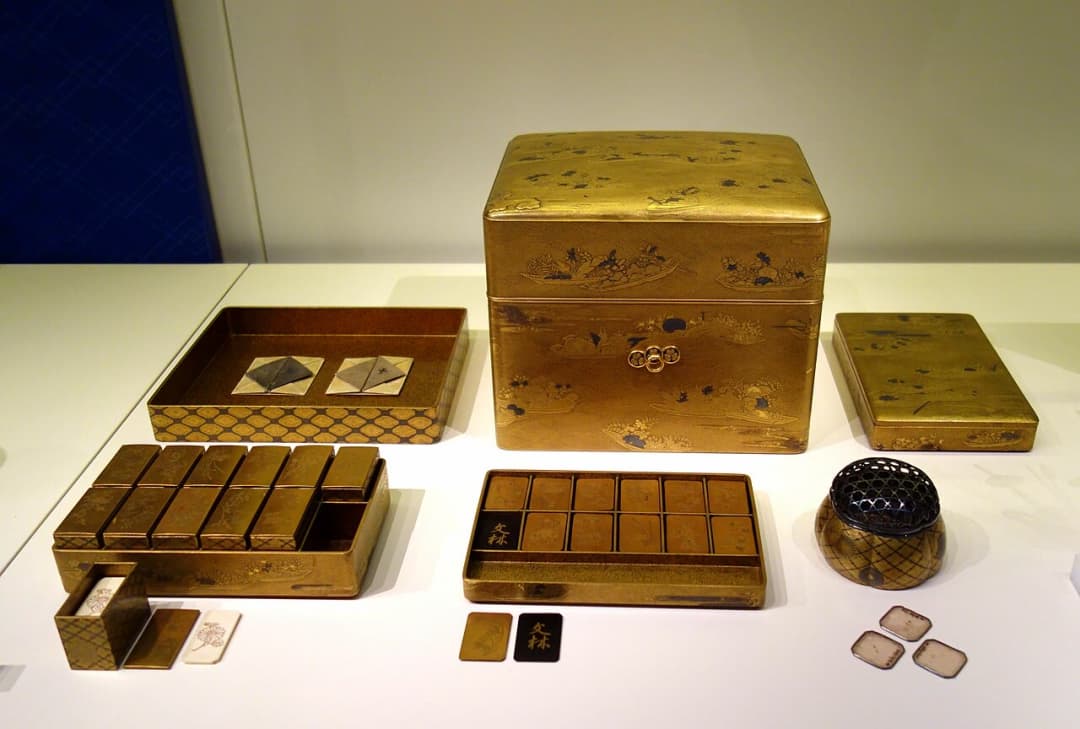
The social half of kōdō is kumikō, the incense-comparing games, and the most famous of them is genjikō. Five kinds of wood are prepared in five packets each. The twenty-five packets are shuffled, five are drawn, and they are heated one after another. Your task is not to name them. It is only to say which of the five were the same as each other and which were different.
There are fifty-two possible answers. They are written as a figure of five vertical strokes, joined across the top by horizontal lines wherever two censers held the same wood — a small diagram called a kō no zu. And because The Tale of Genji happens to have fifty-four chapters, the fifty-two figures were given fifty-two of its chapter names; the first and the last are left out of the scheme.
So a wrong answer in this game is not merely wrong. It is a legible, nameable shape that someone can look at and say: you heard Hana no En when the room heard Aoi. Those figures left the incense room entirely and became a decorative motif, found on kimono and lacquer by people who have never sat at a censer.
Where it came from, and how it hardened
The oldest account is in the Nihon Shoki, which records that in the third year of Empress Suiko's reign — 595 — a large piece of driftwood came ashore on Awaji Island. The islanders used it as firewood, noticed what came off it, and sent it to the court, where Prince Shōtoku is said to have identified it as agarwood.
For the next several centuries incense belonged to Buddhist practice and then to the Heian court, where blending it was a private accomplishment. The hardening into an art with rules came late, in the sixteenth century, and it came from above: the same Ashikaga Yoshimasa who had taken his two squares off Ranjatai set two men to systematising it. Sanjōnishi Sanetaka founded what became the Oie school and Shino Sōshin the Shino school. Both still exist. Both still disagree.
What India did with the same wood
India had the same wood and did something else with it entirely, and the comparison flatters neither side.
There is no Indian grading of incense in this sense — no six names, no five tastes, no school you can be examined by. The expertise went into the making, and into knowing what is appropriate to offer and when. Nobody is scored on what they can detect, because in a puja the incense is not the object of your attention; it is the instrument of it, and it is pointed away from you. A kōdō room inverts that exactly. The smoke, or rather the smokeless warmth, is the entire subject of the room.
So which do you actually want
This is where the confusion costs people money.
If what you want is appreciation — to notice a scent closely, to compare one against another, to get better at it — then you want chips and gentle heat and a quiet room with nothing else burning in it, and you should know that no stick of any origin will give you that. A stick is built to produce a steady, continuous, unexamined scent for half an hour. Grading it is like grading the weather.
If what you want is a scent that marks a time — the start of a practice, the end of a working day, the few minutes before anyone else in the house is awake — then a stick is the correct object, and the correct way to use it is to light it and then stop paying attention to it. Trying to listen to an agarbatti will only make you aware that it is not holding still.
The test is one question: do you want to notice the smell, or do you want the smell to mark something? They are different appetites, and almost all the disappointment I hear about incense comes from buying for one and expecting the other.
The three breaths are worth borrowing anyway. Give the first minute of a stick your whole attention, the way the censer asks you to, and then let it go on without you. You will find you can tell your own incense apart afterwards, which is further than most of us ever get.


